
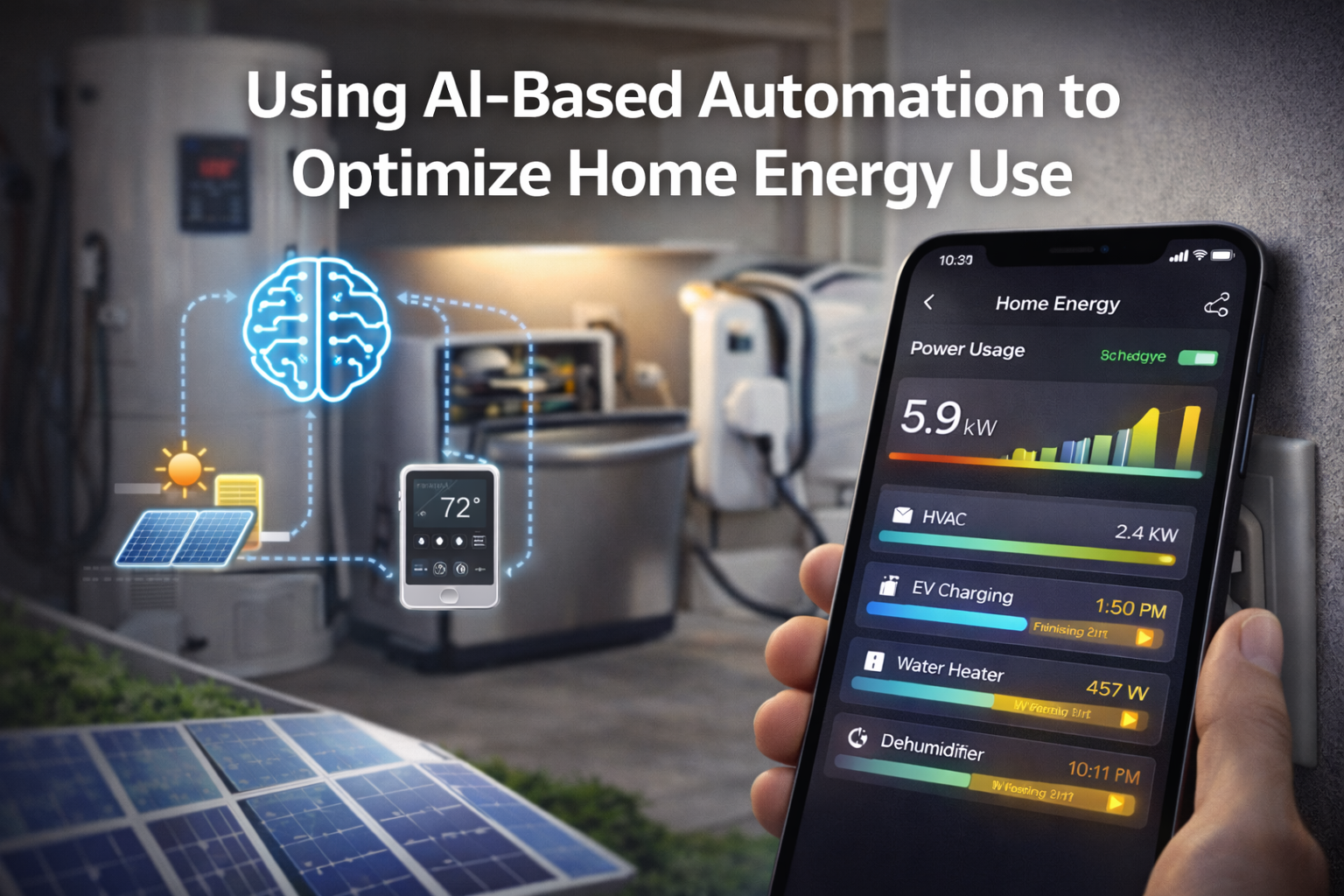
Home energy use has traditionally been managed through habits, schedules, and manual adjustments. People turn thermostats up or down, switch lights off when leaving rooms, and try to run appliances at sensible times. While these actions help, they rely heavily on memory and consistency. In real life, routines change, people get busy, and perfect energy discipline is difficult to maintain.
At the same time, modern homes are filled with data. Smart thermostats record temperature preferences, smart plugs track device consumption, solar systems measure production, and occupancy sensors detect presence. This creates a rich environment of information. However, data alone does not guarantee efficiency. The real value comes from interpreting that data and acting on it in a timely way.
This is where AI-based automation enters the picture. Artificial intelligence can analyze patterns, predict needs, and adjust systems dynamically. Instead of fixed rules, AI can learn how a household behaves and adapt energy use accordingly. Understanding how AI-based automation works in a home context reveals how technology can move from simple control to intelligent optimization.
What AI-Based Automation Means in a Smart Home
AI-based automation in a smart home refers to systems that use algorithms, learning models, and predictive logic to make decisions about devices and energy use. Unlike simple automation that follows fixed rules, AI systems can adapt over time.
For example, a rule-based system might say, “Set the thermostat to 72°F at 7 PM.” An AI-based system might notice that the household usually arrives home between 6:30 and 7:00 PM, that outside temperatures vary, and that electricity is cheaper at certain hours. It can then decide when and how to adjust the temperature for both comfort and efficiency.
AI does not mean a humanoid robot controlling your home. In most cases, it means software analyzing data and making small adjustments automatically. These adjustments often happen quietly in the background.
How AI Learns Energy Patterns
AI systems rely on data. The more consistent and high-quality the data, the better the learning. In a home, this data can include temperature readings, device usage logs, occupancy signals, weather forecasts, and energy prices.
Over time, AI can detect patterns. It may learn when the home is usually empty, when heating demand rises, or when certain appliances are used. It can also detect anomalies, such as unusually high consumption compared to typical days.
Machine learning models look for correlations. For instance, they might connect hot afternoons with higher AC use or weekends with more daytime consumption. With enough history, predictions become more accurate.
This learning process allows the system to move from reactive to predictive behavior.
AI in Heating and Cooling Optimization
HVAC systems are often the largest energy users in a home. Therefore, they are prime candidates for AI optimization. Smart thermostats with AI features can learn preferred temperatures, daily routines, and even how quickly a home heats or cools.
Instead of turning on at a fixed time, the system can pre-condition the home only when needed. It can also factor in weather forecasts. If a warm day is coming, it might reduce heating earlier. If a cool evening is predicted, it might avoid unnecessary cooling.
Some systems also consider energy pricing. They may shift heating or cooling slightly to avoid peak-rate periods while maintaining comfort. These small shifts can add up over time.
AI and Appliance Scheduling
Beyond HVAC, AI can help schedule appliances. Dishwashers, washing machines, dryers, and EV chargers often have flexible timing. AI can recommend or automatically choose times when energy is cheaper or cleaner.
For homes with solar panels, AI can align appliance use with solar production. If midday solar output is high, the system may run certain loads then. This increases self-consumption and reduces grid reliance.
AI can also prevent overlapping heavy loads. Running the oven, dryer, and EV charger at the same time can create peaks. AI-based systems can stagger these to smooth demand.
Integration with Smart Home Ecosystems
AI-based energy optimization works best when integrated with a broader smart home system. Platforms that connect thermostats, plugs, lights, and sensors provide more context.
For example, occupancy data can inform AI whether to maintain comfort settings. If no one is home, energy-saving modes can activate. When someone is on the way back, comfort can be restored.
Voice assistants and apps allow user feedback. If the system makes a choice that feels uncomfortable, users can override it. Good AI systems learn from these overrides.
This feedback loop improves personalization.
Benefits of AI-Based Energy Optimization
One major benefit is convenience. Homeowners do not need to micromanage schedules. The system adapts automatically. This reduces cognitive load.
Another benefit is consistency. AI does not forget to adjust settings. It applies logic every day. Over time, consistent small optimizations can produce noticeable savings.
AI can also improve comfort. By learning preferences, it avoids extreme settings. Optimization does not have to mean discomfort.
Additionally, AI can support sustainability. By aligning use with cleaner energy periods where available, it can reduce environmental impact.
Limitations and Realistic Expectations
AI is not magic. It works within the limits of available data and device control. If a home lacks smart devices or sensors, optimization potential is smaller.
Predictions can also be imperfect. Unusual days, guests, or sudden schedule changes can confuse patterns. That is why user control and override options remain important.
Privacy is another consideration. AI systems often process data about routines and occupancy. Choosing reputable providers and reviewing settings helps maintain comfort with data use.
Most importantly, AI usually delivers incremental improvements, not instant dramatic cuts. Over months and years, those increments matter.
Getting Started with AI-Based Automation
Starting does not require a fully AI-driven house. Many smart thermostats already include learning features. Energy-monitoring platforms may offer insights and recommendations.
Adding smart plugs to major appliances increases visibility. Integrating devices into a central platform improves coordination. Over time, more advanced features can be explored.
The key is to build gradually. Each added data source improves potential optimization.
The Future of AI in Home Energy
AI in home energy is still evolving. Future systems may integrate more deeply with utilities and smart grids. Homes might respond automatically to grid signals, carbon intensity data, or community energy programs.
Predictive maintenance could also grow. AI might detect early signs of failing appliances based on energy signatures. This could save both energy and repair costs.
As homes become more electrified with EVs and heat pumps, intelligent coordination will become even more valuable.
Conclusion
Using AI-based automation to optimize home energy use shifts energy management from manual effort to intelligent support. Instead of relying only on habits and schedules, households can benefit from systems that learn and adapt.
AI does not replace human choice. It enhances it by providing smarter defaults and timely adjustments. Over time, this can reduce waste, smooth peaks, and align energy use with real needs.
The goal is not a perfectly optimized home at all times, but a home that gradually becomes more efficient without constant attention. With thoughtful use, AI-based automation can be a practical ally in creating a smarter and more energy-aware household.
FAQs
Do I need a fully smart home for AI energy optimization
No, but more connected devices increase potential.
Will AI control everything automatically
Usually it suggests or adjusts within limits.
Is it expensive to start
Many features come built into modern smart devices.
Does AI guarantee savings
It improves efficiency but depends on context.
Is my data safe
Choose reputable systems and review privacy settings.

Daniel Harper is a graduate engineer with a postgraduate specialization in Intelligent Solutions and Industry 4.0 technologies. He leads the Mogarzi Team, focusing on smart home automation, residential energy efficiency, and intelligent energy management systems. His work combines engineering principles with practical home optimization strategies, translating complex technical concepts into actionable insights for homeowners seeking smarter and more efficient living environments.