
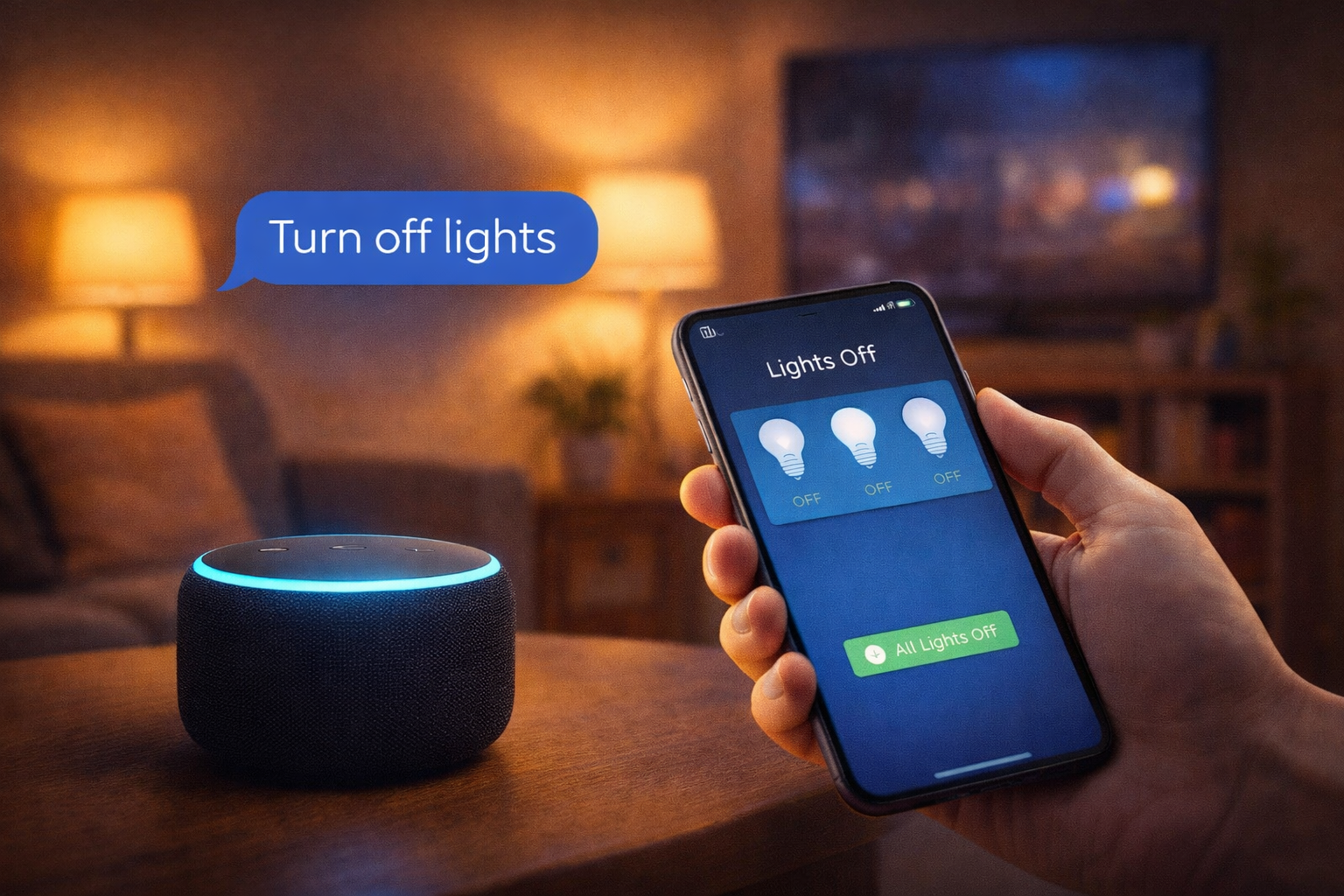
Energy-saving advice often assumes people will remember to act. Turn off the lights. Dim the lamps. Switch to a softer scene. In reality, daily life is full of transitions. People carry groceries, manage children, answer messages, and juggle tasks. In these moments, lighting control is not always top of mind.
Consequently, lights remain on longer than necessary. Not because people do not care, but because effort and attention are limited. This is where voice control introduces a meaningful shift. By lowering the effort required to act, it increases the likelihood that action happens at all.
Voice-controlled lighting routines take this further. Instead of single commands, they bundle multiple actions into one phrase. A simple “Goodnight” can turn off an entire home’s lighting. A quick “Movie time” can dim multiple fixtures. Over time, these routines shape behavior. Exploring how to design them well shows how convenience and efficiency can work together.
Voice-Controlled Lighting Routines That Reduce Daily Energy Use
Why Voice Control Matters in Lighting Efficiency
Efficiency is not only about technology; it is also about usability. If controlling lights requires multiple steps, people delay or skip it. A light that stays on for an extra hour each day may not feel significant, yet over months it adds up.
Voice control removes steps. A spoken command can achieve what previously required movement or app navigation. Because it is quick, it fits naturally into busy routines.
Therefore, voice control supports timely action. Timely action supports efficiency.
The Link Between Convenience and Energy Use
Convenience influences behavior more than intention. People often intend to save energy, yet convenience determines follow-through. If turning off lights is effortless, it happens more often.
Voice routines make efficiency the easy option. When the easy option aligns with the efficient option, savings occur naturally.
This alignment is powerful because it does not rely on constant discipline.
What Voice-Controlled Lighting Routines Are
A voice-controlled routine is a predefined set of actions triggered by a spoken phrase. Instead of controlling one light, it controls many.
For example, a “Leaving home” routine might turn off all lights. A “Dinner time” routine might brighten the kitchen while dimming other areas.
These routines reduce decision-making. Fewer decisions mean less friction. Less friction means more consistent energy-aware behavior.
How Voice Assistants Integrate with Smart Lighting
Voice assistants connect to smart bulbs, switches, and hubs. Through this connection, they can control brightness, color, and on/off states.
Most ecosystems allow grouping lights by room or function. This grouping enables multi-light control through a single command.
Because integration is software-based, routines can evolve. Users can refine them over time.
Why Friction Leads to Energy Waste
Friction in daily tasks often results in delay. A person may think, “I’ll turn that off later,” and then forget. The longer the delay, the longer the light stays on.
Voice control shortens the gap between intention and action. A quick command replaces a postponed task.
Reducing friction reduces forgotten usage.
Behavioral Science Behind Voice Commands
Behavioral research shows that immediate actions are more likely when effort is low. Voice commands fit this principle.
Additionally, spoken routines can become habits. Saying “Goodnight” each evening naturally triggers energy-saving behavior.
Habit-linked commands are especially effective because they integrate into daily rhythms.
Core Types of Voice Lighting Routines
Energy-saving routines often fall into patterns. Whole-home shutoff routines, time-of-day routines, and activity-based routines are common.
Whole-home routines prevent scattered lights from staying on. Time-of-day routines align lighting with natural rhythms. Activity-based routines match lighting to needs.
Each type supports efficiency differently.
Morning Routines That Prevent Overlighting
Morning light often overlaps with daylight. A voice routine can activate only necessary lights rather than all.
For example, a “Good morning” routine can turn on selective lights at moderate brightness. This avoids unnecessary full output.
Selective lighting saves energy while maintaining function.
Evening Wind-Down Routines
Evening routines can gradually dim lights. A “Relax mode” might reduce brightness and shift to warmer tones.
Lower brightness reduces consumption. Warmer tones support comfort.
These routines save energy while improving ambiance.
“All Off” and Whole-Home Commands
A simple “All lights off” command is powerful. It acts as a safety net before bed or when leaving.
Instead of checking rooms individually, one command handles everything. This prevents oversight.
Whole-home commands are among the most effective tools for forgetfulness.
Context-Aware Voice Routines
Context improves routines. For example, a “Movie time” routine can dim living room lights while turning off others.
This prevents unnecessary lighting in unused spaces.
Context-aware routines align lighting with real activity.
Combining Voice with Automation
Voice does not replace automation; it complements it. Automation handles predictable patterns. Voice handles exceptions and quick control.
Together, they create flexibility. Flexibility supports sustained use.
Balanced systems perform best.
Room-by-Room Voice Strategies
Different rooms benefit from different phrases. Kitchens may use cooking-related routines. Bedrooms may use sleep-related commands.
Tailoring by room increases relevance. Relevant routines are used more often.
Usage frequency influences savings.
Avoiding Over-Reliance on Voice Alone
Voice control is helpful but not sufficient alone. If someone forgets to speak the command, lights may remain on.
Therefore, pairing voice with sensors and schedules adds backup.
Redundancy improves reliability.
Privacy and Practical Considerations
Voice assistants process commands through microphones. Users should review privacy settings and choose trusted ecosystems.
Placement also matters. Devices should hear commands clearly without needing repetition.
Practical setup supports smooth use.
Measuring Real Impact
Energy apps and usage logs can show patterns. Reduced nighttime lighting and fewer hours of operation indicate success.
Even without precise data, fewer forgotten lights reflect improvement.
Measurement reinforces motivation.
Long-Term Habit Formation
Voice routines can become rituals. Saying “Goodnight” or “I’m leaving” naturally triggers efficiency.
These rituals require little effort. Over time, they shape habits.
Habit-driven efficiency tends to last.
Conclusion
Voice-controlled lighting routines demonstrate that efficiency can be conversational. By linking spoken phrases to coordinated actions, households reduce friction and prevent common oversights. The real value lies not in novelty but in usability. When turning off lights is as easy as speaking, it happens more consistently. Over time, these small, repeated actions produce meaningful savings. Voice control, in this sense, acts as a bridge between intention and action. It supports people where memory and attention fall short, creating homes that are both convenient and energy-aware.
FAQs
1. Do voice routines save energy by themselves?
They enable timely control, which supports savings.
2. Are they hard to set up?
Most ecosystems offer beginner-friendly setup.
3. Can renters use them?
Yes, with smart bulbs or plugs.
4. Do they require internet?
Most do, though some local control exists.
5. Are they reliable?
When configured well, they are consistent.

Daniel Harper is a graduate engineer with a postgraduate specialization in Intelligent Solutions and Industry 4.0 technologies. He leads the Mogarzi Team, focusing on smart home automation, residential energy efficiency, and intelligent energy management systems. His work combines engineering principles with practical home optimization strategies, translating complex technical concepts into actionable insights for homeowners seeking smarter and more efficient living environments.