
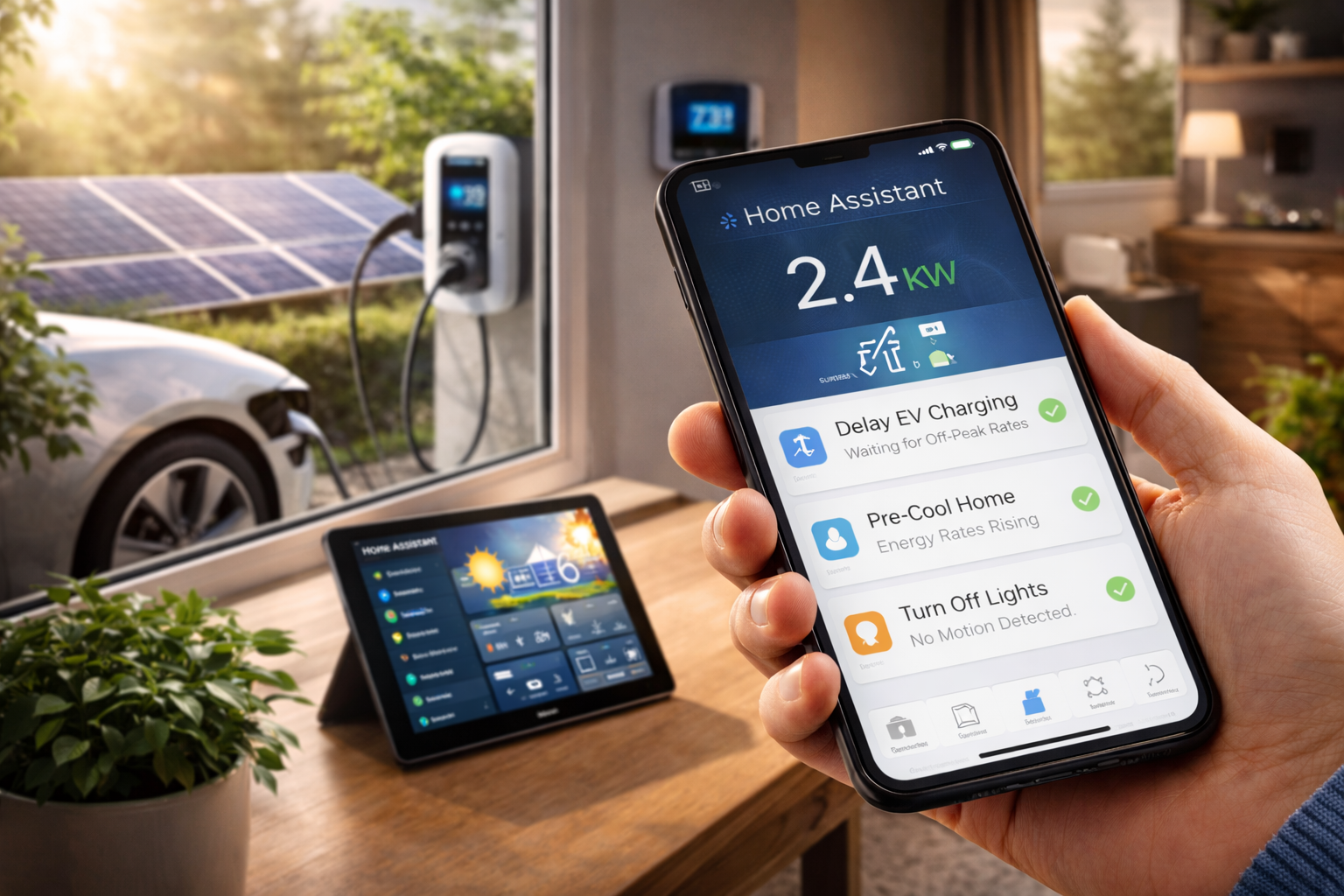
Home energy efficiency often begins with good devices but reaches its full potential with good automation. Many households already use smart thermostats, smart lights, and connected plugs. However, when these devices operate in isolation, their impact is limited. A thermostat cannot know what your lights are doing, and your lights cannot respond to your electricity price schedule. This is where a unifying platform becomes powerful.
At the same time, modern homes generate a growing amount of data. Motion sensors detect presence, smart meters track consumption, weather services provide forecasts, and calendars reflect daily routines. When this information remains separate, it is underused. When it is combined intelligently, it can guide energy-saving decisions automatically.
Home Assistant has emerged as one of the most flexible platforms for this purpose. It allows homeowners to connect devices, sensors, and services into one local, customizable system. More importantly, it enables advanced automations that go beyond simple schedules. Understanding how to use Home Assistant for energy-saving routines reveals how a smart home can become a coordinated, energy-aware system rather than a collection of gadgets.
What Is Home Assistant and Why It Matters for Energy
Home Assistant is an open-source home automation platform designed to run locally, often on a small computer like a Raspberry Pi or a dedicated mini PC. Unlike many cloud-only systems, it emphasizes local control, privacy, and deep customization.
For energy management, this local and flexible nature is important. It allows users to integrate data from many sources. Smart plugs, thermostats, solar inverters, energy monitors, weather APIs, and occupancy sensors can all feed into one dashboard and automation engine.
Because it is open-source, Home Assistant supports thousands of integrations. This makes it possible to build energy routines that reflect a specific home rather than a generic template. A small apartment and a large house can use the same platform but with very different logic.
In essence, Home Assistant acts as the brain that connects energy data with energy actions.
The Difference Between Simple Automation and Smart Energy Automation
Many smart homes already use automation. Lights may turn on at sunset, or a thermostat may follow a schedule. These are useful, but they are often static. They do not react to real-time energy conditions.
Smart energy automation is more dynamic. It responds to context. For example, it can consider:
Current electricity usage
Time-of-use pricing
Solar production
Weather forecasts
Occupancy
Device states
Grid signals where available
Instead of running devices at fixed times, the system can decide when it is most efficient. For instance, it can delay a dishwasher cycle until solar production is high or electricity rates are low.
Home Assistant excels here because it can combine many inputs into one decision.
Setting Up the Foundation for Energy Routines
Before creating advanced routines, a strong foundation helps. This usually includes reliable data sources and controllable devices.
Energy monitors are one of the most valuable inputs. Whole-home monitors or smart meter integrations allow Home Assistant to see total consumption. Smart plugs add device-level visibility and control.
Smart thermostats and HVAC integrations allow climate adjustments. Smart lighting and switches enable load reduction in unused spaces. Presence detection, whether through phone tracking or motion sensors, adds context about occupancy.
Once these elements are connected, Home Assistant can begin to reason about energy in a meaningful way.
Automating Based on Occupancy
Occupancy is one of the most powerful drivers of energy use. Heating, cooling, and lighting empty spaces wastes energy. Yet people do not always remember to adjust settings when leaving.
Home Assistant can automate this gently. When the system detects that everyone has left home, it can reduce HVAC setpoints, turn off unnecessary lights, and power down selected devices. When someone returns, comfort settings can resume.
Because Home Assistant can combine multiple presence signals, such as phone location and door sensors, it can be more reliable than single-device solutions.
This approach reduces waste without requiring constant user attention.
Using Time-of-Use Rates
In regions with variable electricity pricing, timing matters. Running heavy appliances during peak hours can cost significantly more.
Home Assistant can integrate time-of-use schedules or even real-time pricing from utilities. With this information, it can shift flexible loads. For example, a water heater or EV charger can run when rates are lower.
This does not reduce total energy use directly, but it reduces cost and can support grid stability. For many households, cost savings are a strong motivator for efficiency.
Coordinating with Solar and Batteries
Homes with solar panels or batteries gain even more potential. Solar production varies by time of day and weather. Without coordination, some solar energy may be exported to the grid at low compensation rates.
Home Assistant can monitor solar output and align loads with production. It can run appliances when surplus energy is available. It can also coordinate battery charging and discharging strategies where supported.
This turns the home into a more active participant in its own energy management rather than a passive consumer.
Weather-Aware Energy Automation
Weather strongly influences energy use, especially for heating and cooling. Forecast data can be used proactively.
For example, if a hot afternoon is predicted, pre-cooling in the morning when energy is cheaper can reduce peak demand later. If a cold night is coming, slight pre-heating during lower-rate periods may help.
Home Assistant can pull weather forecasts and adjust routines accordingly. This predictive element adds another layer of intelligence.
Load Shedding and Priority Management
In some situations, reducing load quickly is useful. This could be to avoid demand charges or simply to keep consumption under a target.
Home Assistant can define priorities. Critical devices remain on, while flexible loads can be paused. For instance, a pool pump or dehumidifier could be temporarily turned off if total usage exceeds a threshold.
This kind of load management is common in commercial settings but increasingly accessible in homes through platforms like Home Assistant.
Dashboards and Energy Awareness
Automation works best when paired with awareness. Home Assistant includes energy dashboards that visualize consumption, production, and trends.
These dashboards help users understand what automations are achieving. They also build energy literacy. Seeing how different days compare or how solar offsets consumption can be motivating.
However, it is important not to obsess over every fluctuation. Dashboards are tools for insight, not stress.
Avoiding Over-Automation
One common mistake is making automations too complex. If a system behaves unpredictably, users may disable it. Comfort and trust matter.
Energy-saving routines should be gradual and respectful. Small adjustments often work better than drastic ones. For example, slightly adjusting temperature setpoints rather than making large swings.
Testing automations and refining them over time leads to better results.
Privacy and Local Control Advantages
Because Home Assistant runs locally, much of the data stays within the home. For privacy-conscious users, this is appealing. Energy data can reveal patterns about when people are home or away.
Local control also means automations can continue even if the internet is down. For core home functions, this reliability is valuable.
Long-Term Impact on Habits
Over time, Home Assistant can shape habits indirectly. When lights turn off automatically and HVAC adjusts intelligently, people become more accustomed to efficient norms.
The system does not replace human choice, but it nudges behavior. These nudges, repeated daily, create long-term impact.
Energy efficiency becomes part of the home’s default behavior rather than an occasional effort.
Conclusion
Using Home Assistant to automate energy-saving routines transforms a smart home into a coordinated system. Instead of isolated devices, the home becomes a network of sensors and actions working toward efficiency and comfort.
The real strength of Home Assistant lies in flexibility. It can adapt to different homes, climates, and priorities. Whether the goal is lower bills, better sustainability, or simply more awareness, the platform provides the tools.
Ultimately, energy efficiency is not about one perfect automation. It is about many small, thoughtful adjustments supported by good data. Home Assistant enables those adjustments at scale. In doing so, it helps turn intention into consistent action, which is where meaningful savings truly come from.

Daniel Harper is a graduate engineer with a postgraduate specialization in Intelligent Solutions and Industry 4.0 technologies. He leads the Mogarzi Team, focusing on smart home automation, residential energy efficiency, and intelligent energy management systems. His work combines engineering principles with practical home optimization strategies, translating complex technical concepts into actionable insights for homeowners seeking smarter and more efficient living environments.