
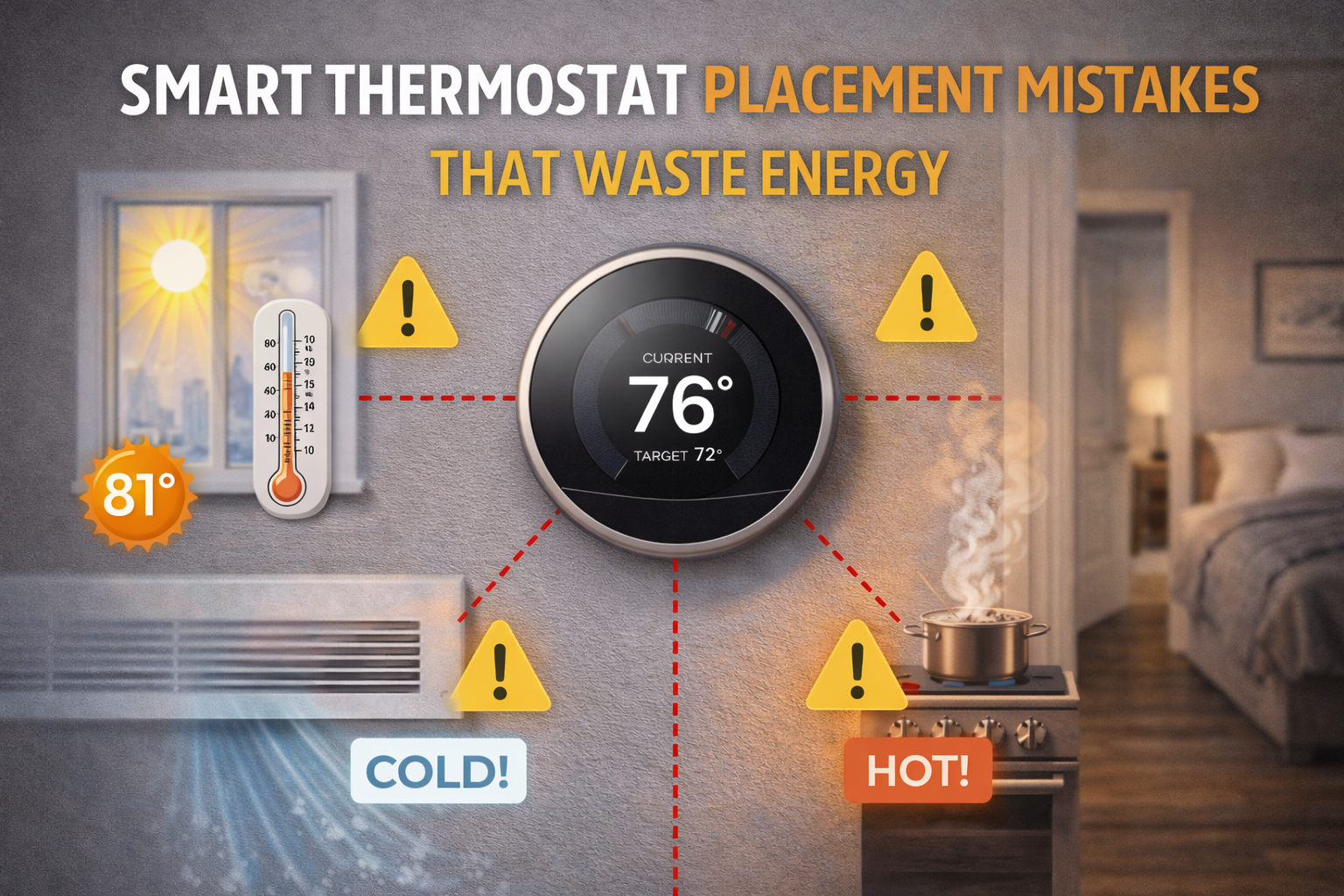
Smart thermostats promise efficiency, comfort, and automation. Yet, many homeowners install them exactly where the old thermostat used to be, assuming intelligence will compensate for physical limitations. Unfortunately, this assumption often leads to disappointing results. Energy bills remain high, rooms feel unbalanced, and comfort fluctuates unpredictably.
The underlying issue is rarely the thermostat itself. Instead, it is how and where the thermostat senses temperature. Because a thermostat governs HVAC behavior based on perceived conditions, even small inaccuracies can have outsized consequences. Over time, these inaccuracies compound, resulting in wasted energy and uneven comfort.
By exploring the most common placement mistakes, it becomes clear that efficiency is not only about features or settings. It is about measurement integrity. Once that concept is understood, correcting inefficiencies becomes far more approachable and far less expensive than many homeowners expect.
Smart Thermostat Placement Mistakes That Waste Energy
Why Thermostat Placement Is Critical for Energy Efficiency
A thermostat acts as the decision-making brain of a heating and cooling system. It determines when the system activates, how long it runs, and when it stops. Importantly, it does so based on a single primary input: the temperature it detects at its location.
When that location does not represent actual living conditions, the thermostat makes systematically flawed decisions. For example, if it senses cooler air than most occupied rooms, it will run heating longer than necessary. Conversely, if it senses warmth that does not reflect occupied spaces, it may reduce heating prematurely.
Because HVAC systems consume substantial energy during operation, even small errors repeated daily can lead to meaningful waste. Therefore, placement is not a minor detail. It is a foundational variable that shapes system behavior every hour of every day.
How a Smart Thermostat Interprets Temperature
Smart thermostats do not simply react to instantaneous readings. They analyze trends, rate of change, and historical patterns. While this sophistication improves stability, it also amplifies consistent bias.
If a thermostat always reads slightly warmer than the rest of the home, it will learn patterns around that distortion. Over time, it may shorten cycles, reduce runtime, or shift schedules based on inaccurate assumptions. Although the system appears intelligent, it is optimizing around flawed data.
As a result, incorrect placement does not just cause momentary inefficiency. It reshapes long-term behavior in ways that quietly increase energy waste.
The Illusion of “Central” Placement
Many installers place thermostats in hallways or central corridors. While this appears logical, it often creates misleading readings. Hallways are transitional spaces, not living spaces. They typically experience less sunlight, fewer heat-generating activities, and lower occupancy.
Because of this, hallways tend to remain cooler in winter and warmer in summer relative to occupied rooms. A thermostat placed there often drives the system to overcompensate. Living rooms may become too warm while bedrooms fluctuate unpredictably.
True centrality should be defined by usage, not geometry. A frequently occupied living area often provides more representative data than a physical midpoint of the home.
Placing the Thermostat Near Windows
Windows introduce significant variability. Sunlight can rapidly raise surface and air temperatures, even in otherwise cool rooms. A thermostat exposed to direct or indirect solar radiation will misinterpret this localized warming as a global condition.
As a result, cooling may activate unnecessarily in summer, while heating may shut off prematurely in winter afternoons. These errors tend to occur during peak solar hours, when energy demand is already high.
Because solar gain changes seasonally, this mistake also creates inconsistent behavior across the year, making it harder to diagnose.
Installing Near Air Vents or Returns
Thermostats placed near supply vents or return ducts experience artificially influenced air temperatures. When heating or cooling activates, these areas change temperature more quickly than the rest of the room.
This causes short-cycling. The system turns on, the thermostat quickly detects the conditioned air, and then shuts off before the home is properly conditioned. Over time, short-cycling increases wear and reduces efficiency.
Additionally, frequent cycling consumes more energy than longer, steadier operation, further increasing waste.
Mounting in Hallways and Transitional Spaces
Beyond central placement issues, hallways pose another challenge: occupancy mismatch. Thermostats in low-occupancy areas prioritize spaces where people spend little time.
As a result, the system optimizes comfort in empty corridors while occupied rooms lag behind. This forces occupants to manually adjust settings, undermining automation and increasing runtime.
Efficiency improves when measurement aligns with where comfort actually matters.
Placement Near Kitchens and Heat Sources
Kitchens generate heat from cooking, appliances, and human activity. Thermostats placed nearby regularly experience temperature spikes unrelated to overall home comfort.
These spikes cause the system to reduce heating or increase cooling prematurely. Consequently, adjacent rooms may cool down or warm up excessively once cooking ends.
This pattern repeats daily, quietly introducing inefficiency through overreaction.
Installing Too High or Too Low
Air stratifies naturally. Warm air rises while cooler air settles. A thermostat mounted too high senses warmer air than occupants experience, while one mounted too low senses cooler air.
This vertical bias leads to consistent miscalculation. Although smart thermostats average readings over time, stratification remains a persistent distortion.
Standard mounting height aligns sensors with human experience, improving accuracy and efficiency.
Ignoring Multi-Room Usage Patterns
Modern homes are rarely used uniformly. Some rooms are occupied throughout the day, while others remain empty. A thermostat placed in a rarely used room optimizes comfort where it is least needed.
As daily routines shift, this mismatch grows more pronounced. Without context from sensors or thoughtful placement, the system cannot adapt.
Efficiency depends on aligning measurement with behavior, not architectural symmetry.
How Remote Sensors Change Placement Strategy
Remote sensors reduce reliance on a single measurement point. They allow thermostats to average or prioritize multiple rooms.
However, the main thermostat’s placement still matters. It often serves as a fallback or reference point. Poor placement can still skew decisions, even with sensors.
The most effective strategy combines thoughtful thermostat placement with strategic sensor deployment.
Seasonal Placement Blind Spots
Some placement mistakes only become apparent in certain seasons. For example, solar gain issues dominate in summer, while stratification problems intensify in winter.
Because of this, homeowners may misdiagnose inefficiencies as seasonal HVAC limitations rather than placement errors.
Evaluating performance across seasons reveals these hidden biases.
Diagnosing Placement Problems
Signs of poor placement include frequent short-cycling, rooms that never feel comfortable, and energy usage that does not align with occupancy.
If adjusting schedules does not resolve these issues, placement should be examined. Measurement errors often masquerade as system flaws.
Correcting Placement Without Rewiring
In many cases, relocation is feasible without major modifications. Alternatively, remote sensors can redirect system focus.
Sometimes, simply disabling reliance on the thermostat’s internal sensor and prioritizing external sensors resolves the issue.
These corrections often deliver immediate improvements.
Conclusion
Smart thermostats are powerful tools, but they are not magic. Their effectiveness depends fundamentally on accurate measurement. Placement mistakes quietly undermine efficiency by feeding distorted data into otherwise intelligent systems. By understanding how location shapes behavior, homeowners can correct inefficiencies without replacing equipment. Ultimately, precision in placement often delivers greater savings than adding new features.
FAQs
1. Can poor thermostat placement really increase energy bills?
Yes, consistent measurement bias leads to longer or more frequent HVAC cycles.
2. Is hallway placement ever acceptable?
Only if the hallway closely reflects occupied spaces, which is uncommon.
3. Do remote sensors eliminate placement issues?
They reduce impact but do not fully eliminate poor main thermostat placement.
4. How high should a thermostat be mounted?
Typically at breathing height, around five feet from the floor.
5. Should placement change between seasons?
Usually no, but seasonal performance should be evaluated to confirm accuracy.

Daniel Harper is a graduate engineer with a postgraduate specialization in Intelligent Solutions and Industry 4.0 technologies. He leads the Mogarzi Team, focusing on smart home automation, residential energy efficiency, and intelligent energy management systems. His work combines engineering principles with practical home optimization strategies, translating complex technical concepts into actionable insights for homeowners seeking smarter and more efficient living environments.