
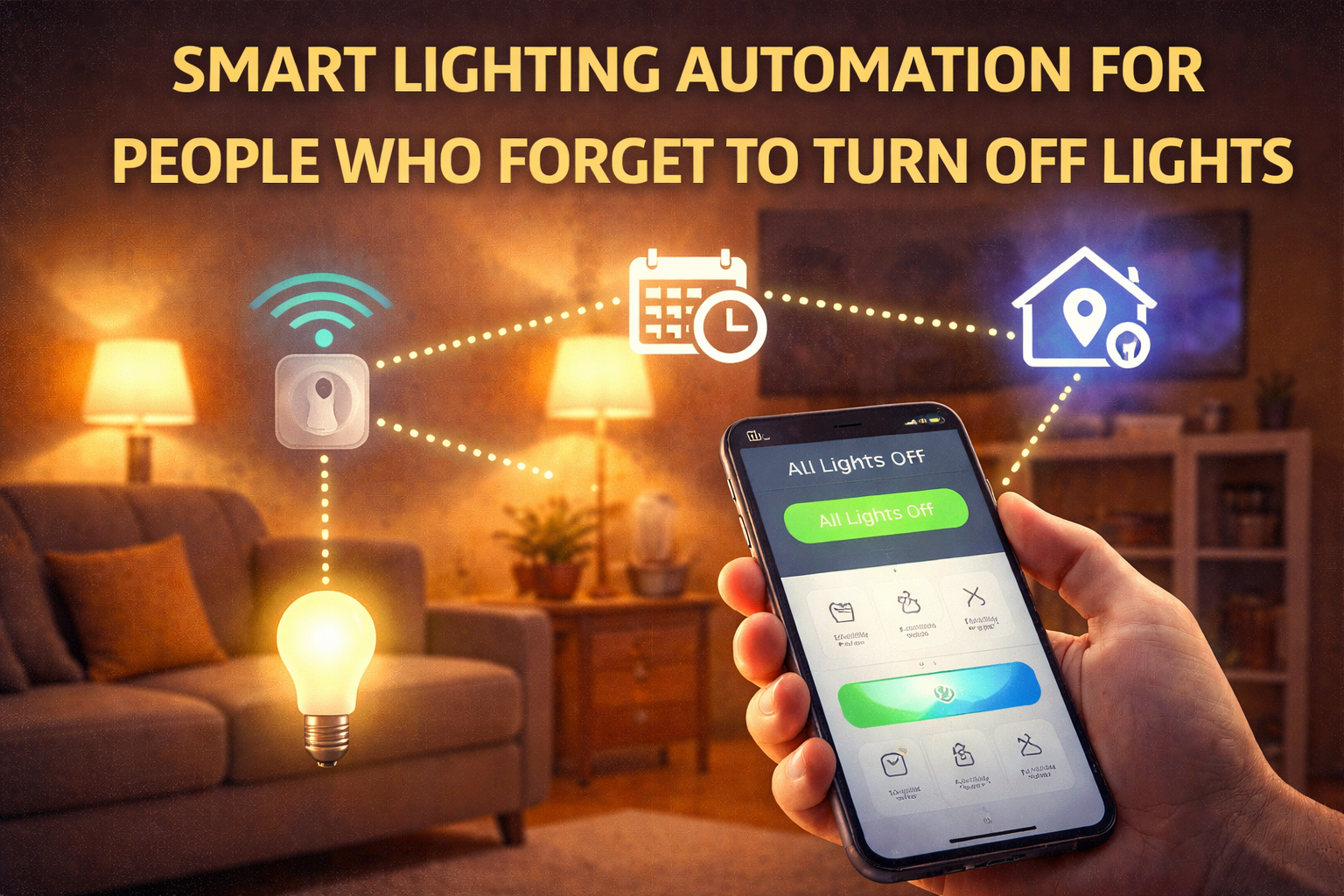
Forgetting to turn off lights is one of the most common and relatable energy habits. It rarely happens out of carelessness. More often, it happens because people are busy, distracted, or simply moving quickly between tasks. A light left on in a bedroom or kitchen can remain on for hours without anyone noticing. Smart lighting automation exists precisely to address this everyday reality.
Modern life is fast and full of transitions. People move from room to room, juggle multiple tasks, and respond to notifications constantly. In this environment, small details like turning off lights are easy to overlook. Even energy-conscious individuals forget occasionally. The issue is not awareness but cognitive load.
At the same time, lighting is used daily and often across many rooms. A single forgotten light may not seem important, yet repeated across days and months, the energy use becomes meaningful. Therefore, the problem is not one big mistake but many small ones.
Smart lighting automation reframes the solution. Instead of asking people to change behavior perfectly, it builds a system that compensates gently. Automation becomes a partner rather than a rule enforcer. Exploring how this works shows how homes can become more forgiving and efficient at the same time.
Smart Lighting Automation for People Who Forget to Turn Off Lights
Why Forgetting Lights Is So Common
Forgetting lights is a normal human behavior. It happens during busy mornings, late evenings, or moments of distraction. When attention shifts quickly, small actions slip through.
Additionally, lighting is passive. Once a light is on, it does not demand attention. Unlike a ringing phone, it does not remind you it exists. Consequently, it blends into the background.
Because forgetting is natural, solutions must account for it rather than fight it.
The Real Cost of Lights Left On
LED lighting is efficient, yet it still uses electricity. A light left on for several extra hours each day accumulates consumption. Multiply this by multiple fixtures, and the impact grows.
Moreover, lights left on overnight or in empty homes contribute to unnecessary use. While each instance is small, the cumulative effect matters.
Therefore, reducing these small wastes is worthwhile.
Why Reminders Rarely Work Long-Term
Some people try notes, routines, or verbal reminders. These can help temporarily. However, habits compete with real-life distractions.
Over time, reminders fade. People adapt and stop noticing them. As a result, the effectiveness declines.
Automation avoids this cycle by removing reliance on memory.
What Smart Lighting Automation Actually Means
Smart lighting automation allows lights to respond to conditions. They can turn off when no motion is detected, when daylight is sufficient, or when the home is empty.
Automation does not eliminate manual control. Instead, it adds intelligence. Users can still switch lights on or off, but the system provides backup.
This hybrid approach balances control and convenience.
Core Technologies Behind Automation
Automation relies on sensors, connectivity, and control platforms. Motion sensors detect activity. Light sensors measure brightness. Smart hubs or apps coordinate logic.
These technologies are mature and widely available. Many setups are plug-and-play.
The key is thoughtful configuration rather than complexity.
Motion Sensors as a Safety Net
Motion sensors are one of the most effective tools. They detect movement and can trigger lights on or off.
In spaces like bathrooms or hallways, they work well because usage is brief. If no motion occurs for a set time, lights turn off.
This prevents lights from staying on unnecessarily.
Occupancy vs Vacancy Detection
Occupancy sensors turn lights on automatically. Vacancy sensors require manual activation but turn lights off automatically.
For people who forget to turn lights off, vacancy logic can be ideal. It preserves user control while ensuring shutoff.
Choosing the right mode matters for comfort.
Schedules and Time-Based Shutoff
Schedules provide structure. For example, lights can turn off at midnight if left on.
This works well for predictable routines. However, schedules alone may not handle exceptions.
Combining schedules with sensors improves flexibility.
Geofencing and Away Modes
Geofencing uses location data. When everyone leaves home, lights can turn off automatically.
Away modes extend this logic. They ensure no lights remain on in empty homes.
This is particularly useful for busy households.
Door and Contact Sensors
Door sensors can trigger lights off when doors close. For example, a closet light can turn off automatically.
This targeted automation prevents waste in small spaces.
It also feels intuitive.
Scene-Based Automation
Scenes coordinate multiple lights. A “Goodnight” scene can turn off all main lights.
This simplifies control. Instead of checking each room, one command handles everything.
Scenes reduce mental load.
Room-by-Room Strategies
Different rooms need different logic. Kitchens benefit from motion-based shutoff. Living rooms may use schedules. Bedrooms often need gentle automation.
Tailoring by room improves satisfaction.
Generic rules rarely fit every space.
Avoiding Annoying Automations
Automation should not fight users. If lights turn off too quickly, frustration occurs.
Longer timeouts or softer dimming can help. Testing and adjustment are important.
Comfort builds trust.
Building Trust in the System
Trust grows when automation behaves predictably. When users feel supported, they keep systems active.
Active systems save energy. Disabled ones do not.
Therefore, user experience matters.
Measuring the Impact
Smart apps often show usage. Reduced runtime indicates savings.
Even without precise numbers, fewer forgotten lights mean progress.
Awareness reinforces good setups.
Long-Term Habit Support
Automation does not replace habits. It supports them. Over time, people still become more mindful.
However, the system catches mistakes. This reduces guilt and waste.
Supportive systems last longer.
Conclusion
Smart lighting automation recognizes that forgetting is human. Instead of expecting perfection, it provides a gentle safety net. By combining sensors, schedules, and scenes, households reduce wasted electricity without adding stress. The goal is not rigid control but supportive design. When lights respond intelligently, they align with real life. Over time, this alignment produces steady savings and more forgiving homes. Automation, in this sense, is less about technology and more about understanding human behavior.
FAQs
1. Do motion sensors always save energy?
When configured properly, they usually do.
2. Are automations hard to set up?
Many are simple and beginner-friendly.
3. Can renters use smart lighting?
Yes, plug-in and bulb solutions work well.
4. Do automations need internet?
Some do, though local hubs can run offline.
5. Is it expensive to start?
It can begin with just one or two devices.

Daniel Harper is a graduate engineer with a postgraduate specialization in Intelligent Solutions and Industry 4.0 technologies. He leads the Mogarzi Team, focusing on smart home automation, residential energy efficiency, and intelligent energy management systems. His work combines engineering principles with practical home optimization strategies, translating complex technical concepts into actionable insights for homeowners seeking smarter and more efficient living environments.