
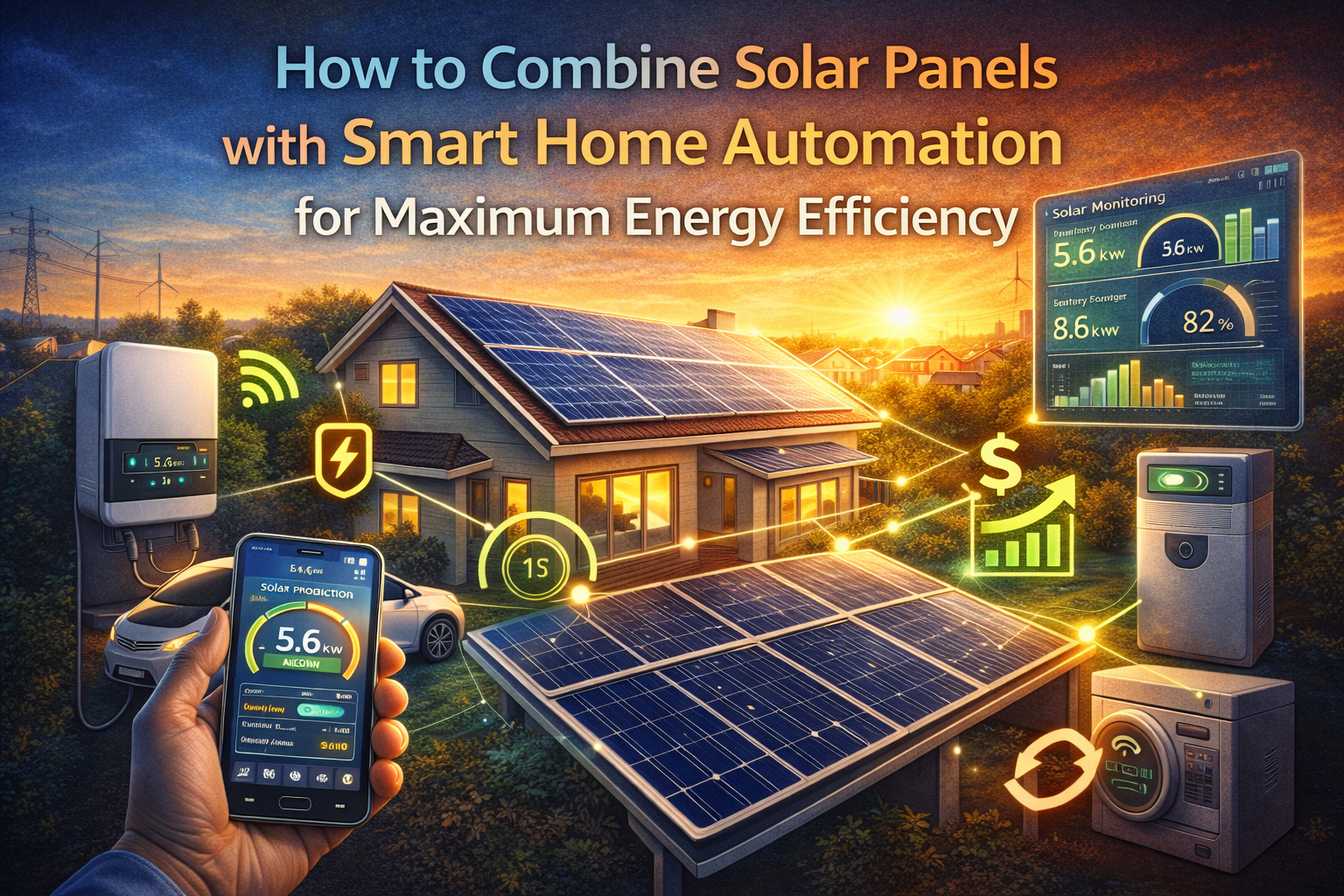
Installing solar panels is a major step toward energy independence. However, generating clean electricity is only part of the equation. The true optimization happens when solar production is intelligently aligned with household consumption.
By combining solar panels with smart home automation, homeowners can significantly increase self-consumption rates, reduce grid dependency, optimize time-of-use pricing, and maximize long-term return on investment (ROI).
In 2026, solar systems are no longer isolated installations — they are becoming integrated components of fully automated energy ecosystems. This article explains how to combine solar generation with automation strategically and efficiently.
Why Solar Panels Alone Are Not Enough
Many homeowners assume that installing photovoltaic panels automatically guarantees maximum savings. In reality, solar efficiency depends heavily on when electricity is consumed.
Solar panels typically produce the most electricity between late morning and early afternoon. However, many households consume the majority of energy in the early morning and evening — when solar production is lower or nonexistent.
This mismatch creates two inefficiencies:
- Excess energy exported to the grid at lower compensation rates
- Higher grid consumption during peak pricing hours
Without automation, homeowners miss opportunities to align consumption with production.
Understanding Self-Consumption Optimization
Self-consumption refers to the percentage of solar energy used directly inside the home instead of being exported to the grid.
Increasing self-consumption improves financial performance because:
- Export tariffs are often lower than retail electricity prices
- Grid purchases during peak hours are more expensive
- Reduced grid reliance increases energy resilience
Smart automation systems allow devices to operate precisely when solar production is strongest, increasing self-consumption ratios significantly.
Core Components of a Solar-Automated Home
Combining solar panels with automation requires coordinated infrastructure.
Solar Monitoring System
A real-time monitoring system provides production data. Without accurate production tracking, automation cannot respond dynamically.
Smart Energy Management Hub
A central controller (or smart home hub) processes data and triggers automated actions based on solar output, time-of-use tariffs, or consumption thresholds.
Smart Loads (Controllable Devices)
Devices that can be automated include:
- Smart thermostats
- Smart water heaters
- EV chargers
- Smart plugs
- Pool pumps
- Washing machines and dryers
These loads can be scheduled or triggered automatically during high solar generation periods.
Practical Automation Scenarios
Automation works best when aligned with predictable solar production patterns.
Scenario 1: Smart HVAC Adjustment
When solar production exceeds household baseline consumption, the system can slightly pre-cool or pre-heat the home. This stores thermal energy in the building envelope, reducing the need for grid-powered HVAC usage later in the evening.
Scenario 2: Automated Water Heating
Water heaters are high-energy loads. Smart controllers can activate heating cycles during peak solar production instead of overnight grid hours.
Scenario 3: EV Charging Optimization
Electric vehicles represent significant electricity demand. Instead of charging immediately after arriving home, automation can delay charging until the next solar production window.
Scenario 4: Appliance Scheduling
Dishwashers and laundry machines can be programmed to operate during midday solar peaks rather than evening hours.
These adjustments, when automated, require no manual intervention after setup.
Integration with Time-of-Use (TOU) Pricing
In regions with time-of-use electricity tariffs, combining solar and automation becomes even more powerful.
Smart systems can:
- Avoid grid consumption during peak pricing
- Shift discretionary loads to off-peak periods
- Prioritize solar use before exporting
This dual optimization — solar production and tariff awareness — maximizes savings potential.
The Role of Battery Storage in Automation
Battery systems further enhance solar automation strategies.
Without storage, excess solar energy must be consumed immediately or exported. With battery integration:
- Excess production can be stored for evening use
- Automation can prioritize battery charging during peak solar hours
- Critical loads can remain powered during outages
Automation platforms can decide dynamically whether to charge batteries, power loads, or export electricity based on predefined optimization rules.
Financial Impact and ROI Considerations
Automation improves solar ROI by increasing usable energy within the home.
Consider a simplified example:
If a household exports 40% of its solar production at a lower feed-in tariff, shifting even half of that exported energy into self-consumption can significantly increase effective savings.
Over a 20-year lifespan, optimized self-consumption may increase total financial return by thousands of dollars.
Automation infrastructure does require initial investment, but when combined with solar — especially during initial installation — the incremental cost is often justified by long-term gains.
Common Mistakes When Combining Solar and Automation
Despite strong potential benefits, several implementation mistakes can reduce effectiveness.
Lack of Real-Time Data Integration
Automation without accurate production data may trigger devices inefficiently.
Over-Automation Without Strategy
Simply connecting devices without energy logic does not guarantee savings. Automation must be structured around production peaks and tariff schedules.
Ignoring Seasonal Variation
Solar output varies significantly across seasons. Automation settings may require adjustment to reflect winter vs summer production patterns.
Failing to Monitor Performance
Even automated systems require periodic review to ensure optimal configuration.
Authority Insight: Solar-Automation as a System-Level Strategy
From an energy systems engineering perspective, combining solar generation with smart automation transforms a passive renewable installation into an active energy optimization platform.
This integration aligns with global energy transition trends:
- Decentralized energy production
- Smart grid interaction
- Dynamic pricing models
- Demand-response participation
Homes that integrate solar and automation are better positioned to adapt to evolving energy markets.
In 2026 and beyond, intelligent load management will increasingly define energy-efficient households.
Solar panels generate energy. Automation ensures that energy is used strategically.
Frequently Asked Questions (FAQ)
Can I combine solar panels with automation without batteries?
Yes. Even without storage, automation can shift loads to align with solar production windows, increasing self-consumption rates.
Is professional installation required?
Basic smart automation can often be configured independently, but integrated solar-energy management platforms may require professional setup for optimal performance.
How much can automation increase solar savings?
Results vary, but increasing self-consumption by 15% to 30% is achievable in many households with proper configuration.
Does automation work during power outages?
Without battery backup, grid-tied solar systems typically shut down during outages for safety reasons. Battery systems are required for backup power functionality.
Is this approach suitable for small solar systems?
Yes. Even smaller installations benefit from consumption alignment, though financial impact scales with system size.
Final Considerations
Solar panels represent the generation side of residential energy independence. Smart automation represents the control layer that determines how effectively that energy is used.
When combined strategically, these systems:
- Increase self-consumption
- Reduce peak grid purchases
- Improve long-term ROI
- Enhance sustainability performance
- Prepare homes for future smart grid integration
In modern energy-efficient homes, solar without automation leaves potential savings untapped. The most forward-thinking homeowners in 2026 are not only generating clean electricity — they are intelligently managing it.

Daniel Harper is a graduate engineer with a postgraduate specialization in Intelligent Solutions and Industry 4.0 technologies. He leads the Mogarzi Team, focusing on smart home automation, residential energy efficiency, and intelligent energy management systems. His work combines engineering principles with practical home optimization strategies, translating complex technical concepts into actionable insights for homeowners seeking smarter and more efficient living environments.