
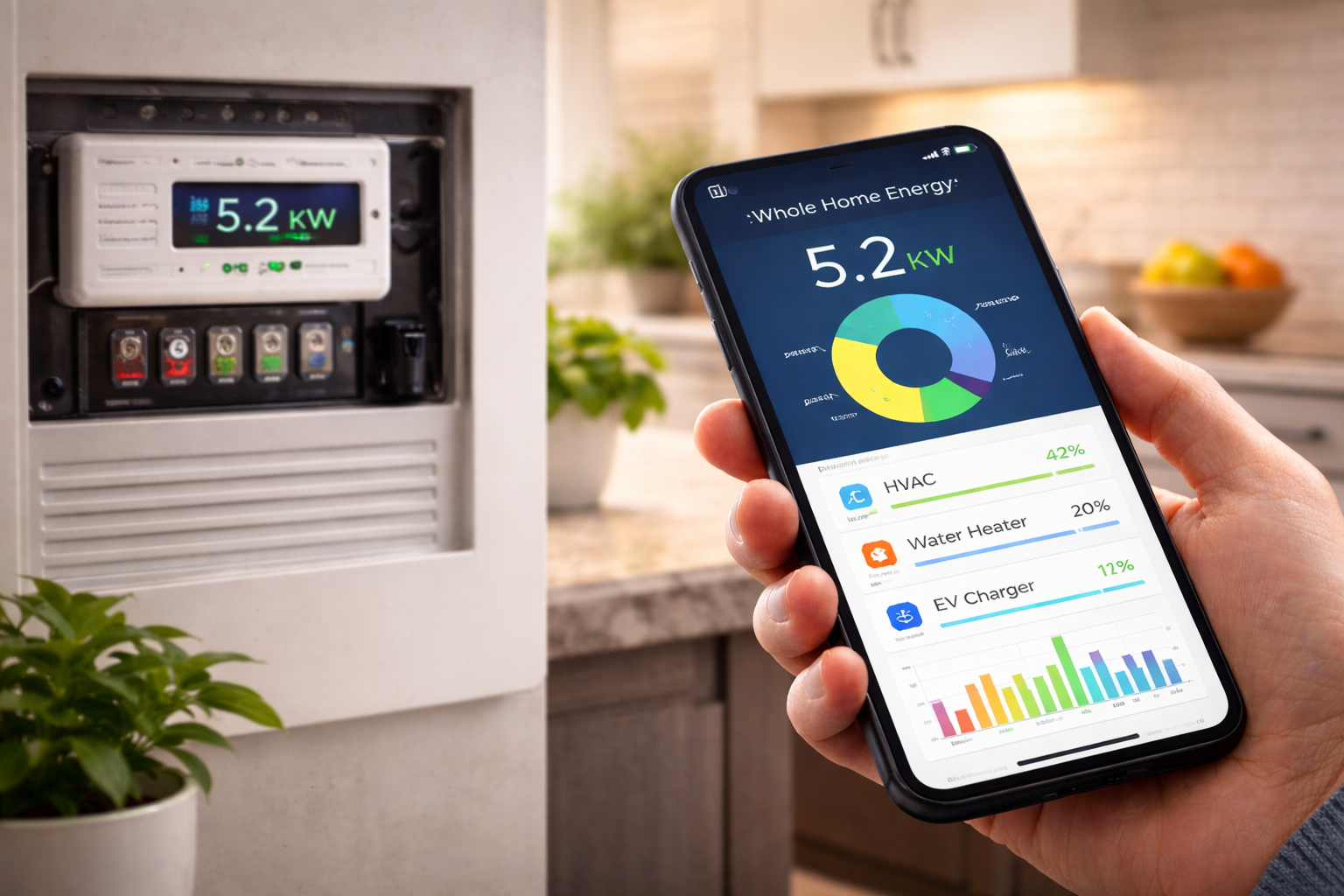
Smart homes are designed to make life more convenient, efficient, and informed. Yet even in highly automated houses, one area often remains surprisingly opaque: total energy use. Many homeowners invest in smart thermostats, efficient lighting, and connected appliances, but still rely on a monthly utility bill to understand their electricity consumption. That bill arrives long after the energy has already been used, which means it is more of a report card than a guidance tool.
At the same time, modern smart houses tend to contain more electrical devices than traditional homes. Always-on routers, smart speakers, security systems, automation hubs, EV chargers, and climate control systems all contribute to a complex energy profile. Because these systems run quietly in the background, their combined impact is easy to underestimate. As a result, even tech-savvy households can struggle to pinpoint where electricity is truly going.
Whole-home energy monitors solve this visibility gap. They allow homeowners to track electricity use in near real time, see patterns, detect anomalies, and make data-driven decisions. Instead of guessing which upgrades matter, homeowners can prioritize based on evidence. When used correctly, a whole-home monitor becomes the foundation of a truly energy-aware smart house.
What Is a Whole-Home Energy Monitor
A whole-home energy monitor is a device that measures the total electricity flowing into a home. It is typically installed at the main electrical panel and uses sensors called current transformers to measure the current on incoming lines. The monitor then sends this data to an app or web dashboard where it is visualized for the user.
Unlike single smart plugs that track one device at a time, whole-home monitors capture the big picture. They show how much power the entire house is using at any moment. Many systems also store historical data, which allows users to compare days, weeks, and months.
More advanced models go further. They attempt to identify individual appliances based on their electrical signatures. For example, a refrigerator has a distinctive on-and-off cycling pattern, while an HVAC system has larger, longer draws. Through machine learning, some monitors learn to distinguish these devices over time.
Importantly, these monitors do not reduce energy use by themselves. They provide insight. The savings come from the actions homeowners take after seeing the data.
Why Whole-Home Monitoring Fits Smart Houses Especially Well
Smart houses already rely on data. Thermostats adjust based on temperature data. Security systems react to sensor data. Lighting responds to occupancy data. In this context, adding energy data is a natural extension.
A smart house without energy monitoring is somewhat blind to its own consumption. Devices may be optimized individually, yet the overall system may still be inefficient. For example, a home could have smart lighting but also an aging HVAC system that dominates energy use. Without monitoring, that imbalance is hard to see.
Moreover, smart homes often have automation routines. Whole-home monitors can inform those routines. For instance, if peak demand times are identified, automations can shift heavy loads to cheaper periods. If unusual nighttime consumption appears, homeowners can investigate standby devices or misconfigured systems.
In other words, energy monitoring turns a smart house into a more self-aware system.
Key Features to Look For
When evaluating the best whole-home energy monitors for smart houses, several features stand out as especially valuable.
Real-time monitoring is fundamental. The ability to see current usage helps connect actions to outcomes. If you turn on an appliance and see the spike immediately, the relationship becomes clear.
Historical tracking is equally important. Trends over time reveal habits and seasonal effects. Heating and cooling loads, for instance, become very visible in monthly comparisons.
Device detection can be helpful, although it varies in accuracy. The best systems improve over time, but users should treat detection as guidance rather than perfect truth.
Integration with smart home platforms is a major advantage for smart houses. Compatibility with ecosystems like Home Assistant, Google Home, or Apple HomeKit allows energy data to influence automations.
Custom alerts also matter. Notifications for unusual spikes, high daily usage, or devices left running too long can act as early warnings.
Finally, a clear and user-friendly app is critical. Data only helps if it is understandable. Good visualization, simple charts, and intuitive summaries make a big difference.
Leading Types of Whole-Home Energy Monitors
While specific brands change over time, most whole-home monitors fall into a few categories.
Panel-installed monitors are the most comprehensive. They connect directly inside the electrical panel and measure total load. These are often the most accurate and feature-rich.
Circuit-level monitors extend this by adding sensors to individual breakers. This allows direct measurement of major circuits like HVAC, ovens, or EV chargers. For smart houses with large loads, this granularity can be very useful.
Utility-based monitors rely on data from smart meters provided by utilities. These can be easy to set up but sometimes have lower resolution or delayed data. Still, they can be a good entry point.
Hybrid systems combine panel sensors with smart plugs. The panel provides whole-home data, while plugs confirm specific devices. This layered approach can improve accuracy.
Installation Considerations
Installation is a key factor. Many whole-home monitors require access to the main electrical panel. This can be straightforward for someone comfortable with electrical work, but it may also require a licensed electrician depending on local rules and personal comfort.
Safety is paramount. Electrical panels contain high-voltage components. Even when the main breaker is off, some parts may remain live. Therefore, homeowners should be realistic about their skills.
Some monitors are designed for simpler installation, using clamp sensors that do not require rewiring. These still need careful handling but are less invasive.
For renters, whole-home monitoring can be harder. In those cases, a combination of smart plugs and portable monitors may be more practical.
Turning Data Into Action
Seeing energy data is only the first step. The real value comes from acting on it.
One common discovery is high standby consumption. Many homes have a surprisingly large baseline load that never drops. This often comes from networking gear, entertainment systems, and always-on devices. Smart power strips or automation can address this.
Another frequent insight involves HVAC systems. Heating and cooling are often the largest loads. Monitoring can show how weather, setpoints, and schedules influence consumption. This can justify thermostat optimization or equipment upgrades.
Time-of-use optimization is another opportunity. If rates are higher at certain hours, heavy appliances can be shifted. Dishwashers, laundry machines, and EV chargers are good candidates.
Maintenance issues can also surface. A refrigerator that suddenly uses more energy could be failing. An HVAC system that runs longer than usual may need service.
Psychological Benefits of Monitoring
Beyond technical benefits, there is a psychological effect. Visibility changes behavior. When people see real-time energy use, they become more mindful.
This does not mean constant checking. In fact, obsessively watching the app can be counterproductive. Instead, periodic reviews build awareness. Over time, homeowners develop intuition about what different loads look like.
This literacy helps in daily decisions and future purchases. Energy efficiency becomes part of the household mindset.
Common Mistakes to Avoid
One mistake is expecting instant, dramatic savings. Whole-home monitors are tools, not magic solutions. Savings accumulate through informed changes.
Another mistake is focusing on tiny fluctuations. Energy data naturally varies. It is better to look at patterns than at minute-by-minute noise.
Some users also install monitors but rarely open the app. In that case, the system cannot deliver value. Even a monthly review is better than none.
Finally, relying entirely on automatic device detection can lead to confusion. Manual labeling and interpretation often improve clarity.
Long-Term Value for Smart Houses
For smart houses, whole-home energy monitors have long-term value. They support better system design, smarter automations, and informed upgrades.
If a homeowner plans to add solar panels or batteries, baseline energy data is essential. It helps size systems correctly and evaluate return on investment.
As grids become smarter and pricing more dynamic, energy data will matter even more. Homes that already track usage will be better positioned to adapt.
Over years, even modest percentage reductions add up financially and environmentally. Monitoring helps sustain those reductions.
Conclusion
The best whole-home energy monitors for smart houses are not just measurement devices. They are awareness tools that support smarter living. By revealing how and when electricity is used, they turn energy from an abstract cost into actionable information.
For smart houses in particular, this data fits naturally into an ecosystem already driven by sensors and automation. It fills a critical gap, allowing the home to be not only connected but also energy-aware.
Ultimately, the goal is not to chase the lowest possible number, but to align energy use with real needs and priorities. Whole-home monitoring makes that alignment possible. In a world where homes are getting smarter every year, understanding energy may be one of the smartest upgrades of all.

Daniel Harper is a graduate engineer with a postgraduate specialization in Intelligent Solutions and Industry 4.0 technologies. He leads the Mogarzi Team, focusing on smart home automation, residential energy efficiency, and intelligent energy management systems. His work combines engineering principles with practical home optimization strategies, translating complex technical concepts into actionable insights for homeowners seeking smarter and more efficient living environments.