
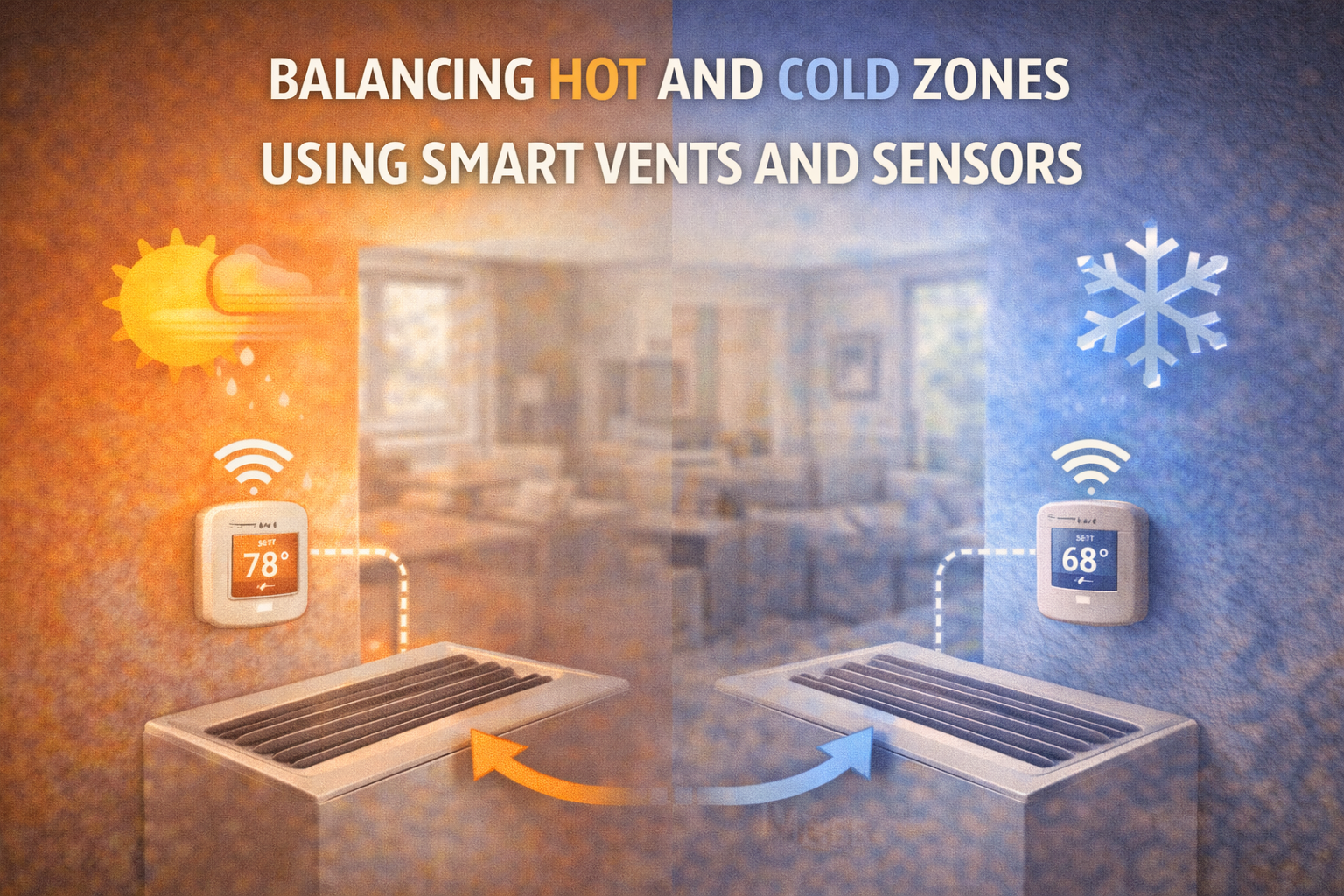
Most homes were not designed with precise zoning in mind. Instead, they were built for generalized comfort, assuming similar needs across rooms. However, modern living has changed how spaces are used. Home offices operate all day, bedrooms remain empty for long stretches, and living areas experience variable occupancy. As a result, temperature preferences and thermal loads differ from room to room.
At the same time, HVAC systems still rely heavily on centralized measurement. A single thermostat reading drives decisions for the entire home. This approach inevitably creates imbalance because it ignores local variation. When one room dictates system behavior, others adapt whether they need to or not.
Smart vents and sensors shift this paradigm. They allow airflow and measurement to reflect actual conditions. Instead of forcing uniformity, they support responsiveness. Exploring how they balance hot and cold zones shows how technology can refine comfort while also improving efficiency.
Balancing Hot and Cold Zones Using Smart Vents and Sensors
Why Hot and Cold Zones Exist in Homes
Temperature differences are not random. They emerge from predictable influences. Sun-facing rooms absorb radiant heat, while shaded rooms remain cooler. Upper floors accumulate warm air because heat rises, while basements stay naturally cooler.
Additionally, duct design influences airflow. Longer duct runs often deliver weaker airflow. Rooms near the HVAC unit may receive stronger conditioning. Even partially closed doors change circulation patterns.
Because of these variables, temperature imbalance is almost inevitable in multi-room homes. The issue is not whether zones exist, but how they are managed.
The Physics Behind Temperature Imbalance
Heat transfer occurs through conduction, convection, and radiation. Walls, windows, and ceilings constantly exchange heat with the outdoors. Meanwhile, indoor air circulates unevenly.
Warm air naturally rises, which means upper levels often experience higher temperatures. Solar radiation through windows adds localized heat. Appliances and electronics generate internal heat gains.
These physical realities mean each room behaves differently. Without localized control, HVAC systems can only approximate balance.
Why Traditional HVAC Struggles With Zoning
Traditional systems operate on a binary principle. They turn on or off based on thermostat readings. While some systems offer multi-stage operation, they still respond to centralized input.
Manual dampers can adjust airflow, but they are static. They do not adapt to daily changes. Once set, they remain fixed until manually changed again.
Therefore, traditional zoning lacks responsiveness. It cannot easily follow dynamic living patterns.
What Smart Vents Actually Do
Smart vents are motorized registers that open or close automatically. They adjust airflow entering a room. When a room reaches its target temperature, the vent can partially close. When more conditioning is needed, it can open.
Importantly, smart vents do not create new air. They redistribute existing airflow. This distinction matters because the HVAC system still determines total output.
Smart vents therefore influence distribution rather than generation. They guide where conditioned air goes.
How Smart Temperature Sensors Add Context
Sensors measure conditions in multiple rooms. They provide localized data that a central thermostat alone cannot capture.
When sensors detect that one room is warmer than others, the system can prioritize airflow there. Conversely, when a room is already comfortable, airflow can be reduced.
This context allows smarter decisions. Instead of assuming uniformity, the system responds to variation.
The Relationship Between Airflow and Comfort
Comfort depends not only on temperature but also on air movement and consistency. A room receiving steady, moderate airflow often feels better than one experiencing bursts.
Balancing airflow reduces extremes. It prevents some rooms from being over-conditioned while others lag behind.
Because HVAC systems operate most efficiently under stable conditions, balanced airflow also supports efficiency.
How Smart Vents and Sensors Work Together
The real value appears when vents and sensors coordinate. Sensors detect conditions, and vents adjust airflow accordingly. This creates a feedback loop.
For example, if a bedroom warms in the afternoon due to sunlight, sensors detect the rise. The system then directs more airflow there. Once the temperature stabilizes, airflow redistributes.
This dynamic balancing reduces hot and cold zones gradually rather than abruptly.
Room-by-Room Balancing Strategies
Different rooms have different roles. Bedrooms may require nighttime comfort. Living rooms need daytime moderation. Home offices demand stable temperatures during work hours.
Smart systems can prioritize rooms based on time of day. This aligns airflow with occupancy patterns.
Over time, patterns emerge. Automation can then refine priorities.
Scheduling and Automation Logic
Automation rules guide vent behavior. Temperature thresholds determine opening percentages. Time-based logic supports daily rhythms.
However, moderation is important. Fully closing too many vents can disrupt system balance. Gentle adjustments work better than extreme ones.
Therefore, automation should be calibrated carefully.
Avoiding Static Pressure Problems
One concern with smart vents is static pressure. If too many vents close, pressure in ducts can rise. This may strain the system.
Quality smart vent systems include safeguards. They limit how many vents close simultaneously. Some integrate pressure sensors.
Proper configuration prevents mechanical issues.
Climate and Home Layout Considerations
Climate influences zoning needs. Hot climates emphasize cooling balance. Cold climates emphasize heat retention.
Open floor plans behave differently than segmented layouts. Air moves more freely in open designs. Zoned homes require more targeted control.
Customization matters. Generic setups rarely optimize performance.
Data-Driven Optimization Over Time
Energy reports and temperature histories reveal trends. Homeowners can see which rooms consistently deviate.
Adjustments can then be made gradually. Small refinements accumulate into better balance.
Data transforms guesswork into informed decisions.
Common Mistakes to Avoid
One mistake is expecting instant perfection. Balancing takes time. Another mistake is over-closing vents.
Ignoring system limits can reduce effectiveness. Patience and moderation usually produce better results.
Long-Term Energy and Comfort Benefits
Balanced zones reduce over-conditioning. Reduced runtime saves energy. Stable operation reduces wear.
Comfort also improves. Fewer complaints about hot or cold rooms mean better satisfaction.
Over years, these benefits compound. Smart zoning becomes a long-term strategy rather than a quick fix.
Conclusion
Balancing hot and cold zones requires more than a powerful HVAC system. It requires awareness and distribution control. Smart vents and sensors introduce both. By measuring conditions locally and adjusting airflow proportionally, they align comfort with real needs. While they do not replace good insulation or duct design, they enhance responsiveness. When configured thoughtfully, they help transform uneven homes into more balanced environments. Ultimately, the goal is not perfect uniformity but adaptive comfort that follows how people actually live.
FAQs
1. Do smart vents replace HVAC zoning systems?
They offer partial zoning but do not fully replace dedicated zoned HVAC.
2. Can closing vents damage HVAC systems?
If excessive, yes. Smart systems include safeguards.
3. How many sensors are needed?
Enough to represent key rooms, usually three to six.
4. Are savings guaranteed?
Savings depend on setup and home characteristics.
5. Do they work in apartments?
They are most effective in ducted systems, which some apartments have.

Daniel Harper is a graduate engineer with a postgraduate specialization in Intelligent Solutions and Industry 4.0 technologies. He leads the Mogarzi Team, focusing on smart home automation, residential energy efficiency, and intelligent energy management systems. His work combines engineering principles with practical home optimization strategies, translating complex technical concepts into actionable insights for homeowners seeking smarter and more efficient living environments.