
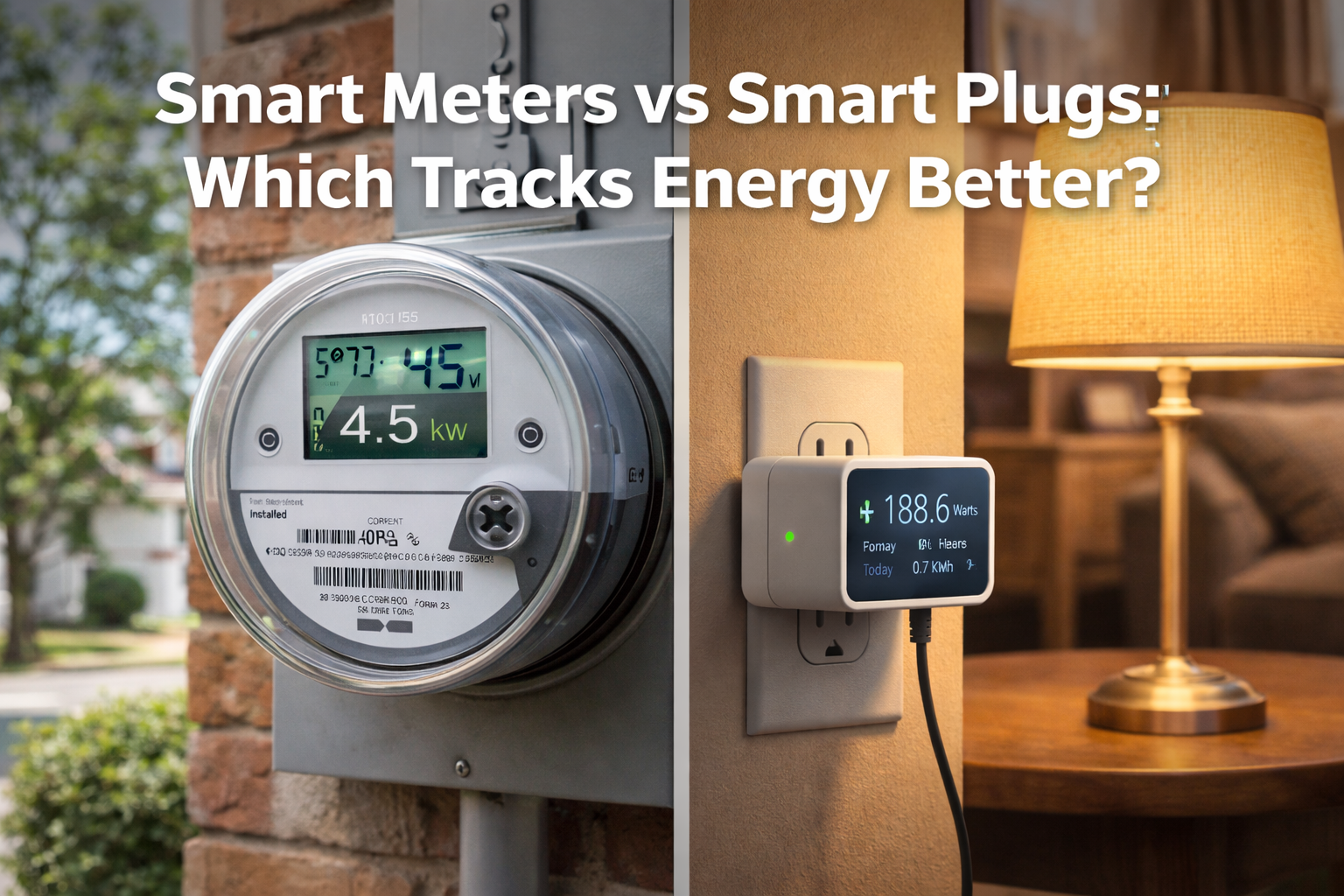
Understanding home energy use has become more important as electricity prices fluctuate, homes become more electrified, and sustainability goals gain attention. Many households want to know where their energy goes, not only to reduce bills but also to make smarter decisions about devices, upgrades, and habits. However, tracking energy accurately can feel confusing because multiple technologies promise insight. Two of the most common are smart meters and smart plugs.
At first glance, both seem to do the same thing. They provide data about electricity use. Yet they operate at very different levels. A smart meter looks at the entire home, while a smart plug focuses on individual devices. Choosing between them, or deciding how to use both, depends on what kind of insight a household actually needs.
The question is not simply which is “better,” but which is better for a given purpose. Some people need big-picture visibility. Others need device-level detail. Some want automation and control. Others want passive monitoring. Exploring how smart meters and smart plugs differ reveals how each fits into a broader energy-awareness strategy.
What Is a Smart Meter
A smart meter is a digital electricity meter, usually installed by a utility company, that measures a home’s total electricity consumption. Unlike traditional analog meters that require manual reading, smart meters automatically send data to the utility. This allows for more accurate billing and, in many cases, more detailed usage information.
Many smart meters record usage in intervals, such as every 15 or 30 minutes. This interval data can show when energy is used throughout the day. Some utilities make this data available to customers through online portals or apps.
Because smart meters are utility-managed, homeowners typically do not install or maintain them. They are part of the grid infrastructure. This makes them widely available but also somewhat limited in customization.
Smart meters excel at showing whole-home consumption and time-based patterns. However, they usually cannot identify individual appliances.
What Is a Smart Plug
A smart plug is a small device that fits between a wall outlet and an appliance. It allows the appliance to be monitored and often controlled remotely. Many smart plugs include energy-monitoring features that show how much power the connected device uses.
Unlike smart meters, smart plugs operate at the device level. They can show real-time watts, cumulative kilowatt-hours, and sometimes cost estimates. Because they are tied to a specific device, they provide very precise information about that device’s behavior.
Smart plugs are user-installed and user-controlled. They connect to home Wi-Fi or a smart home hub. Through apps, users can view data, set schedules, and create automations.
This makes smart plugs both monitoring tools and control tools. They do not just observe; they can act.
Level of Detail: Whole Home vs Device
One of the biggest differences is granularity. Smart meters see the forest. Smart plugs see the trees.
A smart meter tells you that your home used a certain amount of energy between 6 PM and 9 PM. It does not tell you whether that was the oven, the HVAC, or the dryer. You can infer, but not confirm.
A smart plug tells you exactly how much a specific device used. If your dehumidifier runs longer than expected, the plug reveals it. If your gaming PC draws high power, the plug shows it.
Therefore, smart plugs provide clearer answers to device-level questions. Smart meters provide broader context about overall patterns.
Accuracy and Reliability
Both technologies are generally reliable, but in different ways.
Smart meters are utility-grade devices. They are designed for billing accuracy. Their measurements of total home consumption are highly reliable. However, the data customers see may be aggregated or delayed depending on the utility.
Smart plugs are also quite accurate for individual devices, especially quality models. However, cheaper models may have small errors. For most household decisions, their accuracy is sufficient.
In short, smart meters are the reference for total usage. Smart plugs are strong for relative comparisons between devices.
Real-Time Access
Real-time visibility influences how useful data feels.
Some smart meters offer near real-time data through in-home displays or utility apps. Others provide data with delays of hours or a day. This varies widely by region and provider.
Smart plugs almost always provide real-time or near real-time data in their apps. You can turn on a device and immediately see the change. This instant feedback helps connect actions to energy use.
For people who like interactive learning, smart plugs often feel more responsive.
Installation and Accessibility
Smart meters require no action from the homeowner. They are installed by utilities. This makes them easy from the user perspective, but also out of the user’s control. If your utility does not provide detailed access, you cannot change that.
Smart plugs are easy to install. You simply plug them in and connect them to an app. This makes them accessible to renters and homeowners alike.
Because smart plugs are user-owned, you decide how many to use and where.
Control vs Observation
Smart meters are observational. They measure but do not control. They cannot turn devices off or shift loads directly.
Smart plugs combine monitoring with control. You can schedule devices, turn them off remotely, or integrate them into automations. For example, a plug can cut power to a device at night to eliminate standby draw.
This ability to act makes smart plugs powerful tools for reducing waste.
Cost Considerations
Smart meters are usually included in utility infrastructure. There is no direct purchase cost to the homeowner, though costs are indirectly part of the grid system.
Smart plugs must be purchased. Outfitting many devices can add up. Therefore, it is often best to use them selectively on high-impact devices.
From a cost perspective, smart meters are essentially “free,” while smart plugs are targeted investments.
Privacy and Data Control
Smart meters send data to utilities. This data can reveal usage patterns. Utilities have policies and regulations, but data still leaves the home.
Smart plugs send data to manufacturers’ clouds unless they support local control. Privacy-conscious users may prefer local-control models or platforms like Home Assistant.
For some households, data control is an important factor.
Which Tracks Energy Better
The answer depends on what “better” means.
If better means total household accuracy and billing-level measurement, smart meters win. They measure the whole home precisely.
If better means understanding specific devices and behaviors, smart plugs win. They provide actionable detail.
If better means enabling control and automation, smart plugs again have the advantage.
If better means zero effort and universal coverage, smart meters are hard to beat.
In reality, they serve different purposes. One is not a replacement for the other.
The Best Strategy: Combining Both
Many energy-aware homes benefit from both. A smart meter shows the big picture. Smart plugs explain the details.
For example, if the smart meter shows high evening usage, smart plugs can help identify which devices contribute. This layered approach provides clarity.
It also prevents over-monitoring. Not every device needs a plug. High-impact or suspicious devices are the best candidates.
Conclusion
Smart meters and smart plugs are not competitors as much as complements. One shows how the whole home behaves. The other shows how individual devices behave. Together, they create a fuller picture of energy use.
For households serious about efficiency, understanding both levels is valuable. Big-picture trends guide strategy. Device-level data guides action. Neither alone tells the entire story.
Ultimately, the goal is not just to track energy but to use it more intentionally. Whether through a smart meter, smart plugs, or both, visibility is the first step toward smarter energy decisions.
FAQs
Do smart meters replace smart plugs?
No. They serve different levels of monitoring.
Are smart plugs worth it for small devices?
They are most useful for devices that run often or draw significant power.
Can smart meters identify appliances?
Usually not at the consumer level.
Do smart plugs save energy by themselves?
They help by enabling awareness and control.
Is it hard to use both together?
No. Many households naturally use both.

Daniel Harper is a graduate engineer with a postgraduate specialization in Intelligent Solutions and Industry 4.0 technologies. He leads the Mogarzi Team, focusing on smart home automation, residential energy efficiency, and intelligent energy management systems. His work combines engineering principles with practical home optimization strategies, translating complex technical concepts into actionable insights for homeowners seeking smarter and more efficient living environments.