
Heating typically accounts for a large share of household energy consumption, especially in colder regions. Consequently, even small improvements in heating control can produce noticeable savings over time. However, many homeowners focus on upgrading heat sources while overlooking control methods. The result is efficient heat production paired with inefficient heat distribution.
At the same time, modern smart devices promise more precise control. Central thermostats have become smarter, learning schedules and adapting to occupancy. Meanwhile, smart radiator valves offer granular control at the room level. Both approaches sound compelling, yet they solve different problems.
Understanding how each system influences energy use requires looking beyond marketing claims. It involves examining how heat behaves, how homes are used, and how control decisions are made. Once these factors are clear, the comparison becomes far more practical and less theoretical.
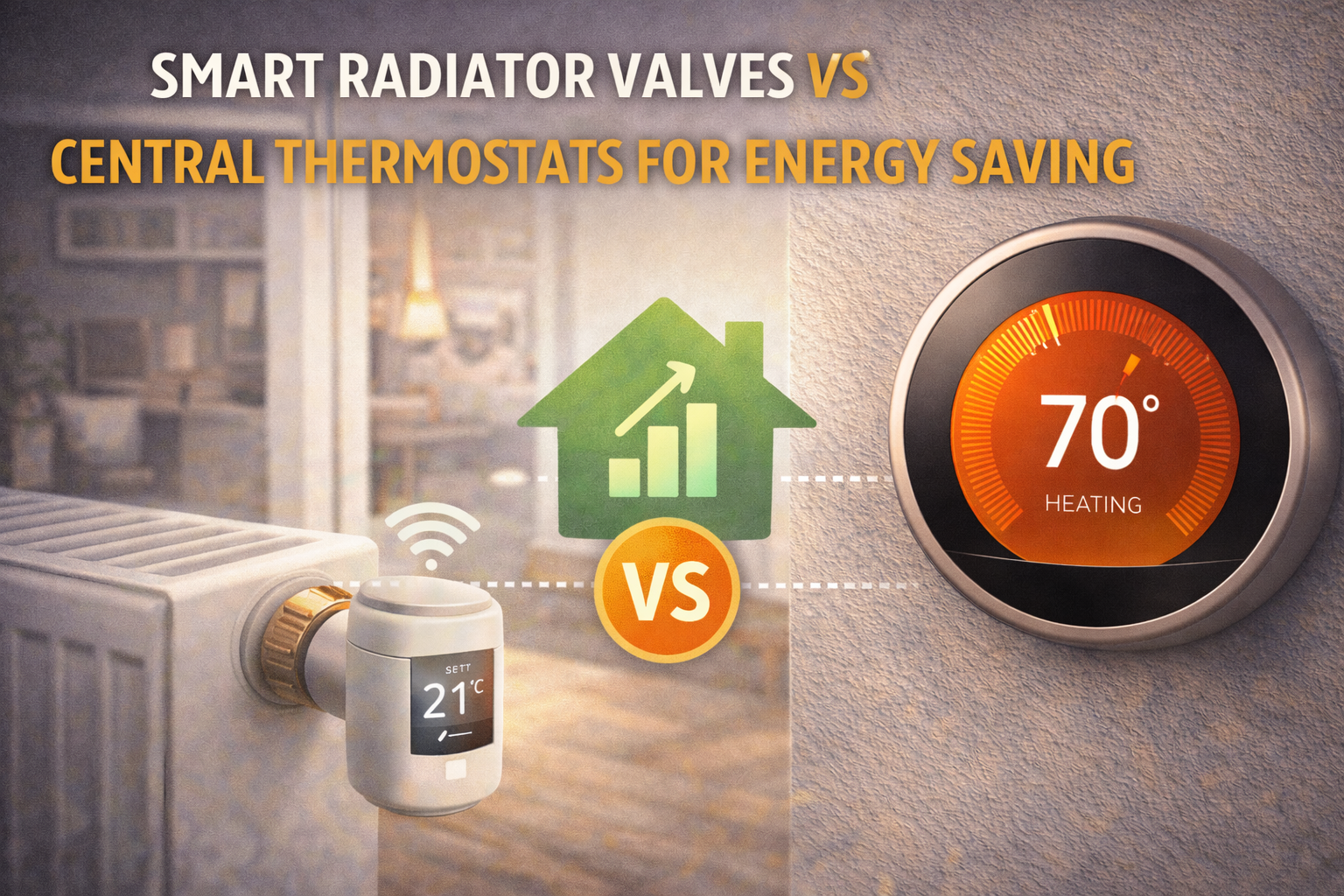
Smart Radiator Valves vs Central Thermostats for Energy Saving
Why Heating Control Strategy Matters
Producing heat is only half of the efficiency equation. The other half lies in delivering that heat where and when it is needed. If heating runs uniformly across all rooms regardless of occupancy, waste becomes almost inevitable.
Many homes have uneven usage patterns. Bedrooms may remain empty during the day. Home offices may be used only part-time. Guest rooms may be occupied rarely. Heating all these spaces equally rarely aligns with actual needs.
Therefore, control strategy determines whether energy use matches lifestyle. Without thoughtful control, even a high-efficiency boiler can support inefficient outcomes.
How Central Thermostats Work
A central thermostat measures temperature in one location and controls the entire heating system accordingly. When the sensed temperature drops below the setpoint, heating activates. When it rises above, heating stops.
Modern smart thermostats add scheduling, learning algorithms, and remote access. They can reduce heating when residents are away and restore comfort before return. Some integrate weather data to refine timing.
However, despite these advancements, the thermostat still relies on a single reference point. That point may not reflect conditions in every room. Consequently, some areas may be overheated while others lag behind.
How Smart Radiator Valves Work
Smart radiator valves attach directly to individual radiators. They regulate hot water flow based on room-specific temperature readings. Each valve effectively becomes a micro-thermostat.
This allows each room to maintain its own setpoint. A bedroom can be cooler while a living room remains warmer. Schedules can differ by space.
Because of this granularity, heating becomes more targeted. Rooms that are not in use can remain at lower temperatures without affecting occupied spaces.
The Core Difference: Centralized vs Room-Level Control
The fundamental distinction lies in control philosophy. Central thermostats treat the home as a unified environment. Smart radiator valves treat it as a collection of zones.
Central control simplifies management but assumes uniform needs. Room-level control recognizes diversity in usage.
Neither approach is inherently superior. Effectiveness depends on how closely control matches lifestyle patterns.
Energy Saving Potential of Central Thermostats
Central thermostats can deliver meaningful savings through scheduling and occupancy detection. Reducing heating during away periods often produces noticeable results.
They are especially effective in smaller homes or apartments where temperature differences between rooms are limited. In such cases, one measurement point may reasonably represent the whole space.
Additionally, central thermostats are simpler. Fewer devices mean fewer points of failure and easier setup.
Energy Saving Potential of Smart Radiator Valves
Smart radiator valves excel where room usage varies significantly. By lowering temperatures in unused rooms, they reduce total heat demand.
This is particularly beneficial in larger homes. Heating a rarely used guest room to full comfort daily provides little value. Valves allow selective heating.
However, savings depend on discipline. If every room is kept warm anyway, the advantage diminishes.
Comfort Implications in Daily Life
Comfort is subjective. Some households prefer uniform warmth. Others accept variation.
Central thermostats promote consistency. Smart valves promote customization. Families with different preferences may appreciate room-level control.
Yet complexity increases with customization. More settings require more management.
Installation and Cost Considerations
Central thermostats typically involve one device. Smart radiator systems require multiple valves. Initial cost can therefore be higher.
Installation complexity also differs. While many valves are user-installable, scaling across many radiators takes time.
Return on investment depends on home size and usage diversity.
Behavioral and Lifestyle Factors
Technology cannot overcome habits. If residents frequently override settings, efficiency drops.
Households with predictable routines benefit more from automation. Those with irregular patterns may need more flexible control.
Therefore, aligning technology with behavior is critical.
Multi-Room Heating Dynamics
Heat distribution is not perfectly isolated. Warmth from one room can influence another. Open doors and shared walls allow transfer.
As a result, precise zoning has limits. Still, targeted control usually reduces overall demand compared to uniform heating.
Hybrid Systems: Using Both Together
Many advanced setups combine both systems. A central thermostat controls boiler operation while smart valves manage room distribution.
This hybrid approach balances simplicity and precision. The boiler runs only when needed, while valves direct heat intelligently.
In many cases, this combination delivers the best results.
Common Misconceptions
One misconception is that smart valves eliminate the need for a thermostat. In reality, a central controller often remains necessary.
Another misconception is that more devices automatically mean more savings. Without thoughtful configuration, complexity can reduce effectiveness.
Long-Term Efficiency Perspective
Efficiency should be viewed over years, not weeks. Gradual savings accumulate. Comfort improvements also have value.
The most effective system is the one that residents use consistently and correctly.
Conclusion
Smart radiator valves and central thermostats represent different paths toward energy efficiency. One emphasizes whole-home simplicity, while the other offers room-level precision. The best choice depends on home layout, lifestyle, and willingness to manage complexity. In many cases, combining both approaches creates a balanced system. Ultimately, energy saving comes not from the device alone but from how well control aligns with real living patterns.
FAQs
1. Do smart radiator valves always save more energy?
Not always. Savings depend on room usage and configuration.
2. Are central thermostats outdated?
No, modern smart models remain highly effective.
3. Can both systems work together?
Yes, hybrid setups are common.
4. Are smart valves difficult to maintain?
They require occasional battery changes but are generally manageable.
5. Which is better for small homes?
Central thermostats often suffice in compact spaces.

Daniel Harper is a graduate engineer with a postgraduate specialization in Intelligent Solutions and Industry 4.0 technologies. He leads the Mogarzi Team, focusing on smart home automation, residential energy efficiency, and intelligent energy management systems. His work combines engineering principles with practical home optimization strategies, translating complex technical concepts into actionable insights for homeowners seeking smarter and more efficient living environments.