
Energy waste at home rarely comes from dramatic misuse. Instead, it usually results from small inefficiencies repeated daily. One of the most common examples is heating or cooling an empty home. Even a few hours of unnecessary HVAC operation each day can accumulate into significant annual energy use.
Traditional programmable thermostats attempted to solve this by following schedules. However, modern life is rarely predictable. Work-from-home days, unexpected outings, and changing routines quickly make fixed schedules outdated. As a result, HVAC systems often run based on assumptions rather than reality.
Geofencing offers a dynamic alternative. Instead of guessing when you are away, your home responds to your actual location. This shift from schedule-based control to presence-based logic represents one of the most practical advancements in residential energy management. Understanding how to use it effectively can noticeably reshape energy consumption patterns.
Using Geofencing to Reduce HVAC Energy When You Leave Home
Why “Away Time” Is One of the Biggest Energy Drains
A large portion of HVAC energy is used during times when comfort is not strictly necessary. Many homes remain empty for work, school, errands, or travel, yet the system continues to maintain full comfort levels.
Even moderate heating or cooling during these periods consumes energy. HVAC systems work hardest to maintain narrow temperature ranges. When no one is present to benefit from that precision, the energy use becomes disproportionate to its value.
Therefore, reducing conditioning during away periods is one of the simplest paths to efficiency. The challenge lies in doing so without creating discomfort upon return.
What Geofencing Actually Means in Smart Homes
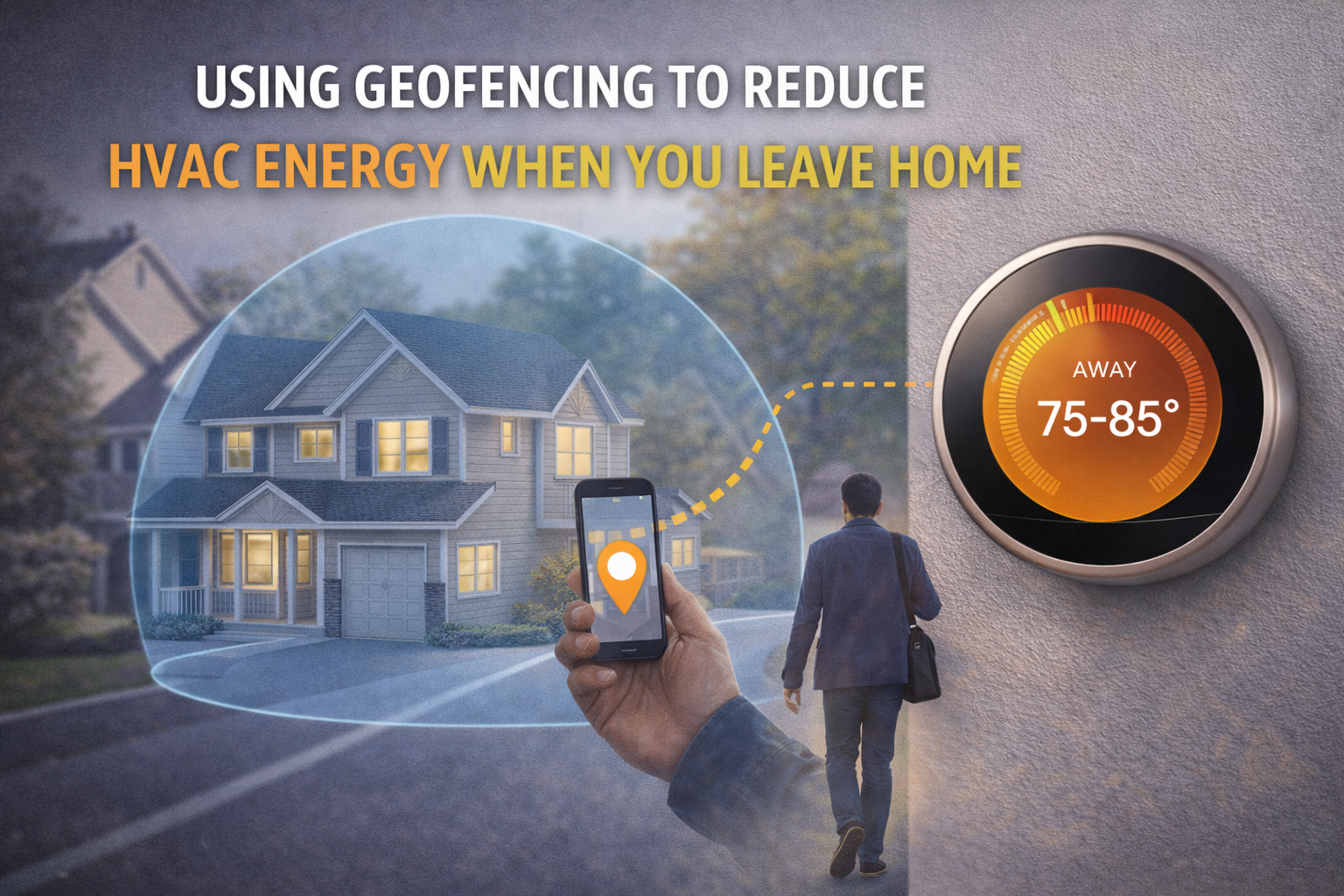
Geofencing creates a virtual boundary around a location. When a smartphone crosses that boundary, it triggers predefined actions. In smart homes, those actions often include thermostat adjustments.
For example, when your phone leaves the geofence radius around your home, the system can enter an energy-saving mode. When you re-enter the boundary, it can restore comfort settings.
This approach relies on real-time data rather than prediction. Consequently, it adapts to irregular schedules far better than fixed programming.
How Geofencing Works With HVAC Systems
Most smart thermostats integrate geofencing through their mobile apps. The app monitors location in the background. When all registered devices leave the geofence area, the thermostat switches to an away setting.
Importantly, away settings do not turn HVAC systems off. Instead, they widen the temperature range. This allows the home to drift slightly warmer in summer or cooler in winter while avoiding extreme conditions.
Because HVAC systems work hardest during tight temperature control, these relaxed ranges often translate into meaningful savings.
Why Manual Setbacks Often Fail
Manual adjustments rely on memory and discipline. People forget to change settings when leaving or feel rushed. Even when they remember, they may hesitate, fearing discomfort later.
Additionally, manual setbacks require reversing the change upon return. This creates friction, and friction reduces consistency. Over time, many households abandon manual strategies altogether.
Automation removes this burden. When the system reacts automatically, efficiency becomes habitual rather than effortful.
The Science Behind Temperature Setbacks
Temperature setbacks reduce the difference between indoor and outdoor conditions. Because heat transfer depends on that difference, smaller gaps slow energy loss or gain.
In winter, allowing the home to cool slightly reduces heat loss. In summer, letting it warm moderately reduces heat gain. The HVAC system therefore runs less frequently.
However, extreme setbacks can backfire. Large recovery periods may require intense HVAC operation. Moderate, consistent setbacks usually produce the best balance.
Setting Up Geofencing the Right Way
Effective setup begins with a realistic geofence radius. A boundary that is too small may trigger away mode during short walks. A boundary that is too large may delay activation.
Many households find that a radius of one to three miles works well. This allows the system time to adjust without reacting prematurely.
Equally important is configuring appropriate away temperatures. The goal is efficiency without risking humidity issues or discomfort.
Multi-Resident Households and Geofencing
Homes with multiple residents introduce complexity. If only one person leaves, the home may still be occupied. Good systems account for multiple devices.
Most platforms allow several phones to be registered. The system enters away mode only when all devices leave the boundary. This prevents accidental setbacks.
However, this requires consistent participation. If one resident disables location services, accuracy declines.
Balancing Comfort and Efficiency
Comfort should remain the priority. If geofencing creates frequent discomfort, people will disable it. Therefore, settings should be moderate.
Some systems offer “eco” modes that are carefully calibrated. These modes provide efficiency without extreme drift.
Testing and refining settings ensures a balance that feels natural.
Common Geofencing Mistakes
Overly aggressive setbacks are a common error. While they appear efficient, they may strain HVAC systems during recovery.
Another mistake is ignoring humidity. In humid climates, allowing temperatures to rise too much can encourage moisture buildup.
Additionally, relying solely on geofencing without schedules may create gaps. Hybrid strategies often work best.
Privacy and Location Concerns
Some homeowners worry about location tracking. It is important to note that geofencing uses data already available to smartphones.
Most reputable platforms encrypt and protect this information. Still, reviewing privacy settings provides reassurance.
Transparency and user control remain key factors.
Combining Geofencing With Other Automations
Geofencing works best when integrated with broader smart home logic. For instance, door sensors can confirm departures. Occupancy sensors can add context.
Weather-based automation can further refine behavior. On mild days, setbacks may be extended. On extreme days, they may be limited.
This layered approach creates resilience and precision.
Long-Term Energy Impact
While daily savings may seem modest, they accumulate. A few kilowatt-hours saved each day become substantial over a year.
Moreover, reduced runtime lowers equipment wear. This can extend HVAC lifespan and reduce maintenance needs.
Over time, geofencing supports both energy and system health.
Conclusion
Geofencing transforms how homes respond to absence. Instead of relying on rigid schedules or memory, HVAC systems adjust based on real movement. When set up thoughtfully, this approach reduces unnecessary runtime while preserving comfort. By aligning heating and cooling with actual occupancy, homeowners gain a practical, low-effort path toward better efficiency. The technology works quietly in the background, yet its cumulative impact can be significant.
FAQs
1. Does geofencing drain phone batteries?
Modern smartphones handle background location efficiently, so impact is minimal.
2. What happens if my phone battery dies?
Some systems default to home mode or rely on other devices.
3. Can geofencing work without internet?
It requires connectivity to communicate with the thermostat.
4. Is it suitable for apartments?
Yes, especially where schedules vary.
5. How much can it save annually?
Savings vary, but many households see noticeable reductions.

Daniel Harper is a graduate engineer with a postgraduate specialization in Intelligent Solutions and Industry 4.0 technologies. He leads the Mogarzi Team, focusing on smart home automation, residential energy efficiency, and intelligent energy management systems. His work combines engineering principles with practical home optimization strategies, translating complex technical concepts into actionable insights for homeowners seeking smarter and more efficient living environments.