
Introduction
Solar energy adoption continues to accelerate worldwide in 2026. Falling panel costs, improved efficiency, smart home integration, and rising electricity prices have made residential solar one of the most attractive long-term investments for homeowners.
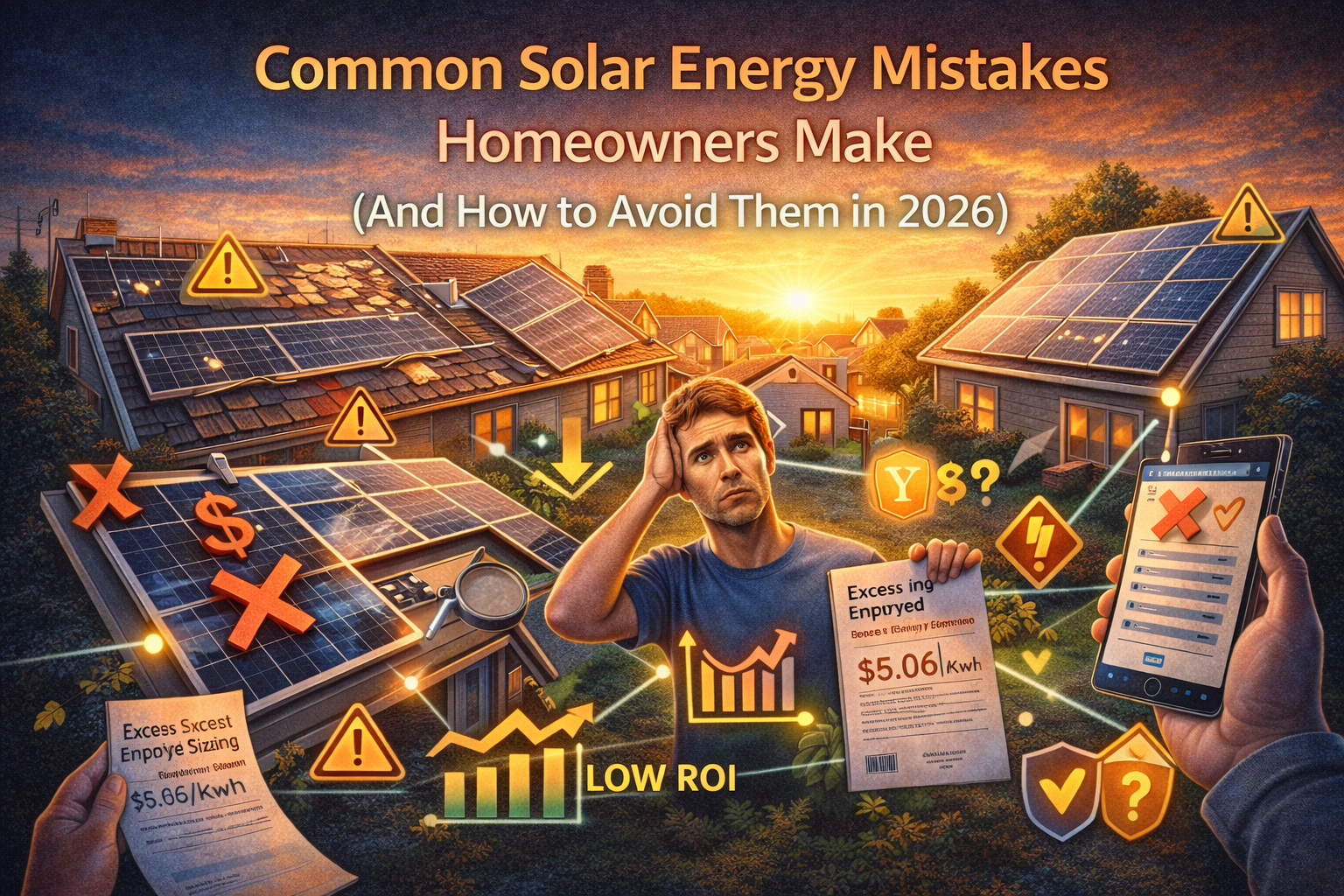
However, despite technological advancements, many homeowners still make critical mistakes when planning, installing, and managing solar systems. These mistakes can reduce system performance, delay ROI, create safety risks, or limit long-term scalability.
This article explores the most common solar energy mistakes homeowners make, why they happen, and how to avoid them — with a technical and strategic approach aligned with modern smart energy standards.
Mistake #1: Oversizing or Undersizing the Solar System
The Problem
One of the most frequent errors is failing to correctly size the photovoltaic (PV) system.
- Undersized systems fail to cover energy needs, reducing savings.
- Oversized systems may generate excess electricity that is exported at low compensation rates (depending on local policies).
In regions with reduced net metering incentives, oversizing can significantly impact ROI.
Why It Happens
Homeowners often:
- Estimate consumption without reviewing 12 months of utility data.
- Ignore seasonal consumption variations.
- Fail to account for future electrification (EVs, heat pumps).
The Correct Approach
A proper sizing strategy includes:
- Historical consumption analysis (kWh/year).
- Peak load evaluation.
- Solar irradiance assessment.
- Future load projections.
- Smart energy modeling software simulation.
Professional installers use production modeling tools such as those integrated into platforms from companies like Enphase Energy and SolarEdge Technologies to optimize system capacity.
Mistake #2: Ignoring Roof Condition and Orientation
The Problem
Installing solar panels on a roof that:
- Needs replacement soon.
- Has structural limitations.
- Faces poor orientation or shading.
This can reduce system lifespan or require expensive reinstallation.
Technical Considerations
- Ideal tilt angle depends on geographic latitude.
- South-facing roofs (in the Northern Hemisphere) maximize annual production.
- Shading from trees or nearby buildings can reduce output dramatically.
Advanced systems using microinverters (like those from Enphase Energy) or power optimizers (such as SolarEdge Technologies) mitigate shading losses — but do not eliminate poor placement.
Best Practice
Before installation:
- Conduct structural inspection.
- Evaluate roof age.
- Perform shading analysis using solar pathfinder tools.
- Consider ground-mount alternatives if roof is unsuitable.
Mistake #3: Focusing Only on Panel Price (Ignoring System Quality)
The Problem
Many homeowners choose installers based solely on the lowest quote.
This often results in:
- Lower efficiency modules.
- Weak warranties.
- Inferior inverters.
- Poor installation quality.
- Limited monitoring capabilities.
Why It’s Risky
The inverter is the heart of the system. Cheap components increase:
- Failure risk.
- Downtime.
- Maintenance costs.
- Fire hazards.
High-quality systems from manufacturers like Canadian Solar and JinkoSolar provide better long-term performance guarantees.
Strategic Perspective
Solar should be evaluated as a 20–30 year infrastructure investment, not a short-term expense.
Total Cost of Ownership (TCO) matters more than upfront savings.
Mistake #4: Not Integrating Solar with Smart Energy Management
The Problem
Many installations stop at basic solar production — without intelligent load management.
This leads to:
- Low self-consumption rates.
- Excess grid export.
- Missed savings opportunities.
Smart Optimization in 2026
Modern smart homes integrate:
- Real-time monitoring.
- Smart thermostats.
- EV chargers.
- Load scheduling automation.
Energy management platforms from companies like Tesla and Sonnen enable:
- Automated peak shaving.
- Battery prioritization.
- Dynamic tariff optimization.
Without automation, homeowners lose efficiency gains.
Mistake #5: Ignoring Battery Storage Planning
Even if homeowners do not install batteries immediately, failing to design a system that supports future storage is a strategic mistake.
Why This Matters
Electricity markets are shifting toward:
- Time-of-use tariffs.
- Reduced net metering.
- Grid instability.
Battery-ready systems are increasingly essential.
Products like the Tesla Powerwall and systems from LG Energy Solution require compatible inverter infrastructure.
Planning for future storage avoids costly retrofits.
Mistake #6: Underestimating Maintenance and Monitoring
Solar systems are low maintenance — not zero maintenance.
Homeowners often:
- Ignore monitoring apps.
- Fail to notice performance drops.
- Skip annual inspections.
Common issues include:
- Inverter faults.
- Dirt accumulation.
- Wiring degradation.
- Loose connections.
Modern monitoring platforms (like those provided by SolarEdge Technologies) allow:
- Per-panel performance tracking.
- Real-time alerts.
- Remote diagnostics.
Without monitoring, losses can go unnoticed for months.
Mistake #7: Not Verifying Installer Credentials
The solar industry has grown rapidly, attracting inexperienced contractors.
Risks include:
- Improper grounding.
- Code violations.
- Insurance issues.
- Safety hazards.
Homeowners should verify:
- Licensing.
- Insurance.
- Manufacturer certifications.
- Installation portfolio.
- Warranty support structure.
Long-term system reliability depends heavily on installation quality.
Mistake #8: Ignoring Local Policy and Incentive Changes
Solar economics vary significantly by region.
Key variables:
- Net metering policies.
- Tax credits.
- Grid interconnection rules.
- Feed-in tariff rates.
In the United States, federal incentives such as the Investment Tax Credit (ITC) significantly impact ROI calculations.
Failing to model policy scenarios may lead to inaccurate financial projections.
Authority Insight: Solar Is an Energy Strategy, Not Just a Product
The biggest overarching mistake homeowners make is treating solar as a standalone purchase instead of a comprehensive energy strategy.
In 2026, solar must be viewed as part of a broader system including:
- Smart automation.
- Storage.
- EV integration.
- Dynamic pricing optimization.
- Energy efficiency upgrades.
Homes that treat solar strategically achieve:
- Faster ROI.
- Greater resilience.
- Higher property value.
- Long-term grid independence.
Frequently Asked Questions (FAQ)
How long does it take to see ROI on a residential solar system?
Typically 5–10 years, depending on electricity rates, incentives, and system size.
Is battery storage necessary?
Not always — but increasingly strategic as time-of-use pricing expands.
Do solar panels require frequent maintenance?
Minimal maintenance is required, but monitoring and annual inspection are recommended.
Can I expand my solar system later?
Yes, if inverter capacity and electrical infrastructure are designed for scalability.
Does shading completely ruin solar performance?
No, but it reduces output. Microinverters and optimizers help mitigate shading effects.
Final Considerations
Solar energy remains one of the most powerful investments homeowners can make in 2026. However, poor planning and short-term decision-making can significantly reduce system effectiveness.
Avoiding common mistakes requires:
- Proper sizing.
- Quality components.
- Smart system integration.
- Future-ready infrastructure.
- Professional installation.
- Continuous monitoring.
When approached strategically, solar energy transforms from a cost-saving tool into a cornerstone of a resilient, intelligent, and financially optimized smart home.

Daniel Harper is a graduate engineer with a postgraduate specialization in Intelligent Solutions and Industry 4.0 technologies. He leads the Mogarzi Team, focusing on smart home automation, residential energy efficiency, and intelligent energy management systems. His work combines engineering principles with practical home optimization strategies, translating complex technical concepts into actionable insights for homeowners seeking smarter and more efficient living environments.