
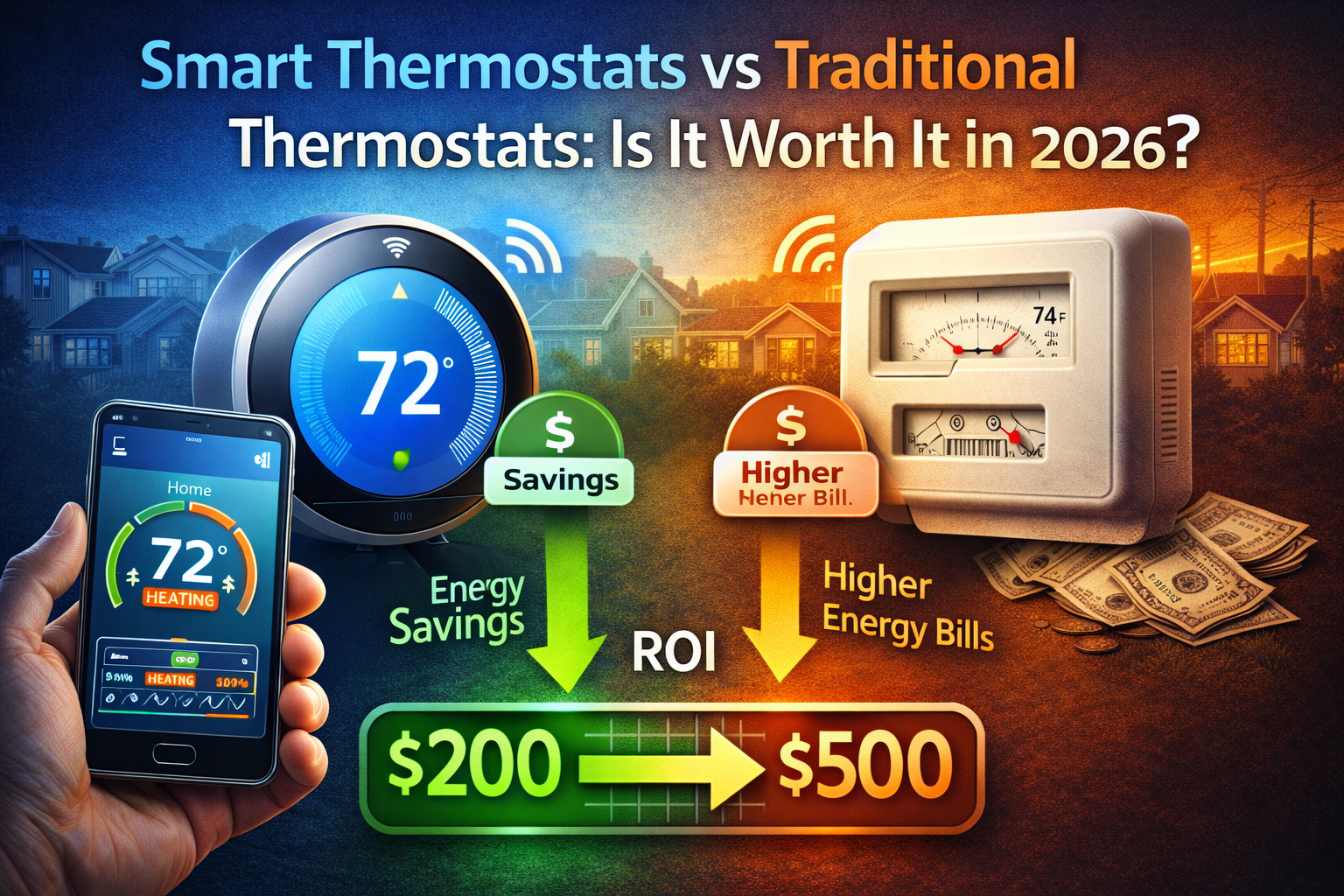
Heating and cooling systems account for the largest share of residential energy consumption in most households. In many regions, HVAC systems represent between 40% and 60% of total electricity usage. Because of this, even small efficiency improvements can generate substantial financial savings over time.
One of the most debated upgrades in smart home energy optimization is the transition from a traditional thermostat to a smart thermostat. While the marketing promises energy savings, automation, and convenience, the real question remains: does it actually deliver measurable financial and efficiency benefits?
This article provides a technical, financial, and practical comparison to determine whether upgrading is truly worth the investment.
How Traditional Thermostats Work
Traditional thermostats operate on a reactive control principle. They measure indoor temperature and activate or deactivate the HVAC system when the ambient temperature deviates from the setpoint.
There are two primary types found in most homes.
Mechanical Thermostats
Mechanical thermostats use a bimetallic strip or mercury switch to detect temperature changes. When the metal expands or contracts due to temperature variation, it physically triggers the HVAC system.
While durable and inexpensive, mechanical thermostats suffer from several limitations. Their temperature calibration can drift over time, and they often allow wider temperature swings before activation, which reduces efficiency and comfort consistency.
Digital Programmable Thermostats
Digital thermostats allow users to program temperature schedules based on time of day. For example, lowering heating during work hours and increasing it before returning home.
Although more efficient than mechanical models, they still rely entirely on manual programming. If schedules change or are not optimized properly, energy waste continues. Studies show many homeowners never fully configure programmable thermostats correctly, which limits potential savings.
Most importantly, traditional thermostats lack real-time adaptability. They do not respond dynamically to occupancy, weather forecasts, or utility pricing fluctuations.
How Smart Thermostats Operate
Smart thermostats integrate sensors, Wi-Fi connectivity, machine learning algorithms, and cloud-based analytics to create adaptive climate control systems.
Instead of functioning purely as reactive devices, they operate as predictive control systems.
Adaptive Learning
Many smart thermostats learn occupancy patterns over time. By analyzing manual adjustments and motion sensor data, they automatically optimize heating and cooling schedules without requiring manual programming.
This reduces energy waste during unoccupied hours.
Remote Control and Automation
Through smartphone apps, users can adjust temperature settings remotely. If someone forgets to turn off the AC before leaving, adjustments can be made instantly.
Smart thermostats can also integrate with:
- Smart home hubs
- Solar monitoring systems
- Energy management platforms
- Utility demand-response programs
This enables coordinated automation across the entire home.
Data Analytics and Insights
Unlike traditional models, smart thermostats provide detailed energy usage reports. Homeowners can analyze daily, weekly, and monthly consumption patterns, identify inefficiencies, and optimize accordingly.
This data-driven approach is one of the most significant differences between traditional and smart systems.
Energy Savings: What Does the Data Suggest?
The primary motivation for upgrading is energy savings.
Research from energy agencies and manufacturers suggests that smart thermostats can reduce heating costs by 10% to 15% and cooling costs by 10% to 20%, depending on climate and usage behavior.
However, savings depend on three key factors:
- Climate severity
- Home insulation quality
- Occupancy patterns
Homes with irregular occupancy benefit the most. If residents frequently leave during the day or travel often, automated setback scheduling generates noticeable reductions in runtime hours.
In contrast, homes with consistent occupancy and already optimized programmable schedules may see smaller marginal gains.
Cost Comparison and ROI Analysis
A traditional thermostat typically costs between $20 and $60. Installation is straightforward and rarely exceeds minimal labor fees.
Smart thermostats range from $150 to $350, with potential professional installation costs depending on HVAC compatibility.
The ROI calculation depends on annual energy savings.
For example:
If a household spends $2,000 annually on heating and cooling, and a smart thermostat reduces consumption by 12%, that equals $240 in yearly savings.
In this scenario, a $250 device pays for itself in roughly one year.
However, in milder climates with lower HVAC expenses, the payback period may extend to two or three years.
From a long-term perspective, considering a device lifespan of 8 to 10 years, cumulative savings often significantly exceed the initial investment.
Comfort and Environmental Impact
Energy savings are only part of the equation.
Smart thermostats improve thermal consistency by minimizing temperature swings. Instead of large activation cycles, they often use optimized micro-adjustments that maintain steadier comfort levels.
Additionally, reduced HVAC runtime lowers overall carbon emissions. In regions where electricity is generated from fossil fuels, this can meaningfully decrease a household’s environmental footprint.
When integrated with solar panels, smart thermostats can prioritize climate control during peak solar production hours, further improving sustainability performance.
Limitations and Considerations
Despite their advantages, smart thermostats are not universally beneficial.
Compatibility issues may arise in older HVAC systems without a C-wire or advanced control board.
Data privacy is another consideration, as these devices collect occupancy and usage information.
Furthermore, homeowners who rarely adjust their temperature and already maintain optimized schedules may experience modest savings compared to the upgrade cost.
Therefore, the value proposition depends on behavioral and structural factors, not just device capability.
Authority Insight: Why Smart Thermostats Represent a Structural Shift
From an energy efficiency engineering perspective, smart thermostats represent a shift from reactive control to predictive optimization.
Traditional thermostats operate on fixed thresholds. Smart thermostats incorporate feedback loops, occupancy detection, and data modeling.
This aligns with broader trends in smart energy management, where optimization is driven by data analytics rather than static configuration.
In the context of 2026 and beyond, as energy pricing becomes more dynamic and utilities adopt time-of-use billing, smart thermostats gain additional relevance. They enable automated responses to peak pricing periods, reducing operational costs without requiring manual intervention.
This capability positions them not merely as comfort devices, but as strategic energy management tools.
Frequently Asked Questions (FAQ)
Do smart thermostats really save money?
Yes, particularly in homes with variable occupancy patterns. Savings typically range between 10% and 20% on HVAC-related energy consumption, depending on climate and usage.
Are smart thermostats difficult to install?
Most modern systems are designed for DIY installation. However, older HVAC systems may require a C-wire adapter or professional installation.
Do they work with all heating and cooling systems?
Not all. Compatibility should be verified before purchase, especially in homes with multi-stage systems or older furnaces.
How long does it take to see ROI?
In high-consumption households, ROI can occur within 12 to 24 months. In lower-consumption environments, it may take up to three years.
Are smart thermostats worth it in small apartments?
The financial benefit may be smaller due to reduced HVAC load, but automation and remote control features still provide convenience value.
Final Considerations: Is It Worth It?
The decision ultimately depends on context.
If your household has high heating or cooling costs, irregular occupancy, or interest in broader smart home integration, a smart thermostat is likely a financially sound investment.
If energy consumption is already optimized and occupancy remains constant, the economic advantage may be less dramatic, though comfort and automation benefits still apply.
In 2026, as smart grids expand and energy pricing becomes more dynamic, smart thermostats are transitioning from optional gadgets to strategic infrastructure components within energy-efficient homes.
For homeowners focused on long-term savings, sustainability, and intelligent automation, the upgrade is not merely about convenience — it is about control, optimization, and measurable efficiency gains.

Daniel Harper is a graduate engineer with a postgraduate specialization in Intelligent Solutions and Industry 4.0 technologies. He leads the Mogarzi Team, focusing on smart home automation, residential energy efficiency, and intelligent energy management systems. His work combines engineering principles with practical home optimization strategies, translating complex technical concepts into actionable insights for homeowners seeking smarter and more efficient living environments.