
Introduction: The Hidden Energy Drain in Most Homes
Most homeowners focus on large appliances when thinking about energy savings. Air conditioners, heaters, and refrigerators usually get the most attention. However, a less visible but persistent form of waste occurs silently every day: standby power consumption.
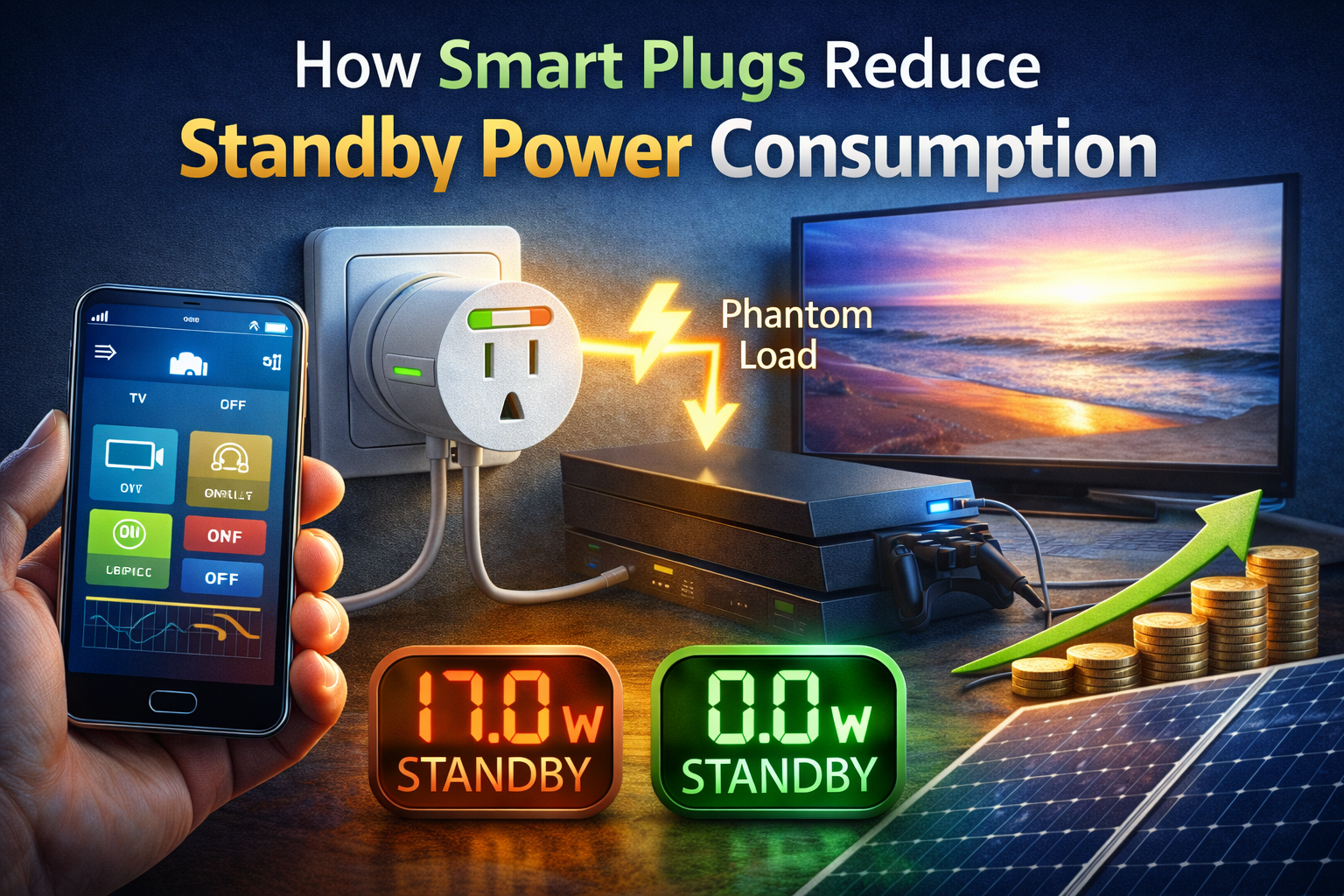
Even when devices appear to be turned off, many continue drawing electricity. Televisions remain in ready mode, gaming consoles stay connected to the internet, microwaves power their digital displays, and chargers consume energy even without a device attached. This invisible consumption is often called phantom load or vampire energy.
Smart plugs offer one of the simplest and most cost-effective solutions to this problem. When used strategically, they can significantly reduce unnecessary electricity use without affecting daily comfort.
What Is Standby Power Consumption?
Standby power refers to the electricity consumed by devices when they are not actively in use but remain plugged in. Modern electronics are designed to stay partially powered for quick startup, remote activation, updates, or display functions.
Individually, the energy draw may seem small — often between 1 and 10 watts per device. However, when multiplied across dozens of devices operating 24 hours a day, the impact becomes measurable.
Energy efficiency studies estimate that standby power can account for 5% to 10% of total household electricity consumption. In practical terms, a home spending $1,800 per year on electricity could be losing between $90 and $180 annually to devices that are technically “off.”
The problem is not intensity, but persistence. Standby devices consume energy continuously.
How Smart Plugs Work
Smart plugs are intermediary devices installed between a wall outlet and an appliance. Once connected to Wi-Fi, they allow users to control power delivery through a smartphone app or automation platform.
Their core advantage is not remote control convenience — it is automation logic.
Smart plugs can:
- Completely cut power during defined hours
- Shut down devices after inactivity
- Activate based on occupancy detection
- Monitor real-time energy consumption
- Provide historical usage reports
Unlike simply unplugging a device manually, smart plugs allow structured control that operates daily without user intervention.
The Financial Impact of Eliminating Phantom Load
The financial benefit of smart plugs depends on how many high-standby devices are present in a home and how consistently automation is applied.
Consider a typical living room setup:
Device | Average Standby Draw | Annual Cost (Estimated)
Television | 5W | $8–$12
Gaming Console | 10W | $15–$25
Sound System | 3W | $5–$8
Cable Box / Streaming Device | 8W | $12–$20
When grouped together, a single entertainment center can cost $40 to $60 per year in standby electricity. Multiply this across bedrooms, home offices, and kitchen appliances, and the total grows quickly.
A strategically placed set of smart plugs can eliminate most of this cost with a relatively low upfront investment. In many households, payback periods range between 6 and 18 months.
Where Smart Plugs Deliver the Greatest Savings
Not every device should be connected to a smart plug. The highest return comes from appliances that:
- Have noticeable standby consumption
- Do not require constant power
- Are used on predictable schedules
Entertainment systems, home office equipment, coffee machines, printers, and decorative lighting are strong candidates.
Refrigerators, medical devices, and internet routers generally should not be placed on automated shutdown schedules unless carefully configured.
Strategic selection is more important than quantity.
Smart Plugs and Behavioral Awareness
One overlooked benefit of smart plugs is data visibility. Many models include built-in energy monitoring that shows real-time and historical consumption.
When homeowners can see that a rarely used device consumes 50 kWh annually without active use, behavior changes naturally. Awareness drives optimization.
In this sense, smart plugs function not only as control devices but also as educational tools that reveal hidden inefficiencies.
Automation Scenarios That Maximize Savings
Night Shutdown Routine
Entertainment systems and office equipment can automatically turn off after midnight and reactivate in the morning. This alone eliminates 6 to 8 hours of unnecessary standby power daily.
Workday Mode
During weekday working hours, non-essential devices can remain completely disconnected until occupancy sensors detect activity.
Vacation Mode
When homeowners travel, smart plugs can shut down all non-essential devices while maintaining minimal systems for security or monitoring.
Automation ensures savings occur consistently without relying on memory.
Limitations and Common Mistakes
Smart plugs are not universal solutions. Overuse can create inconvenience, especially if devices lose configuration settings after power disconnection. Some appliances, such as certain smart TVs or routers, may require constant power for updates or connectivity.
Another mistake is assuming smart plugs alone will dramatically cut energy bills. While they reduce standby waste, major consumption still comes from climate systems and large appliances. Smart plugs should be viewed as part of a broader efficiency strategy rather than a standalone solution.
Cost vs Return on Investment
Entry-level smart plugs are relatively affordable, and multi-pack options reduce per-unit cost. A moderate setup for key areas of a home often requires a modest initial investment.
If standby power accounts for 7% of a $2,000 annual energy bill, that equals $140 per year. Eliminating even half of that waste produces measurable savings. In many cases, homeowners recover their investment within the first year.
Beyond direct savings, smart plugs contribute to a culture of energy awareness that supports additional optimization layers.
Frequently Asked Questions
Do smart plugs really reduce electricity bills?
Yes, particularly by eliminating standby power consumption. Savings vary but typically reduce 3% to 8% of total household electricity use when applied strategically.
Are smart plugs safe?
Reputable models include overload protection and meet electrical safety standards. However, they should always be used within rated capacity limits.
Can smart plugs damage electronics?
When properly rated and configured, they do not harm devices. However, sensitive equipment should be evaluated individually.
Do I need many smart plugs to see results?
No. Targeting high-standby clusters, such as entertainment centers and home offices, often generates noticeable savings without widespread installation.
Author and Expertise
This article was developed by the Mogarzi Research Team, specializing in residential energy optimization and smart home efficiency systems. Our analysis integrates appliance standby consumption data, automation use cases, and real-world cost modeling to provide practical strategies rather than theoretical recommendations.
Final Perspective
Smart plugs represent one of the simplest entry points into smart home energy optimization. While they will not transform an energy bill overnight, they eliminate persistent invisible waste that accumulates over time. When combined with climate control optimization and energy monitoring — topics explored in our complete beginner’s guide — they become a foundational layer in a structured smart energy strategy.

Daniel Harper is a graduate engineer with a postgraduate specialization in Intelligent Solutions and Industry 4.0 technologies. He leads the Mogarzi Team, focusing on smart home automation, residential energy efficiency, and intelligent energy management systems. His work combines engineering principles with practical home optimization strategies, translating complex technical concepts into actionable insights for homeowners seeking smarter and more efficient living environments.