
Introduction
Energy efficiency discussions often remain theoretical. Homeowners read about automation, solar integration, battery storage, and intelligent load management — but many still ask the same practical question: does it actually work in real homes?
The answer depends on integration depth, behavioral patterns, and system design. While no two homes are identical, real-world implementations demonstrate that measurable reductions in electricity bills are achievable when smart systems are configured strategically.
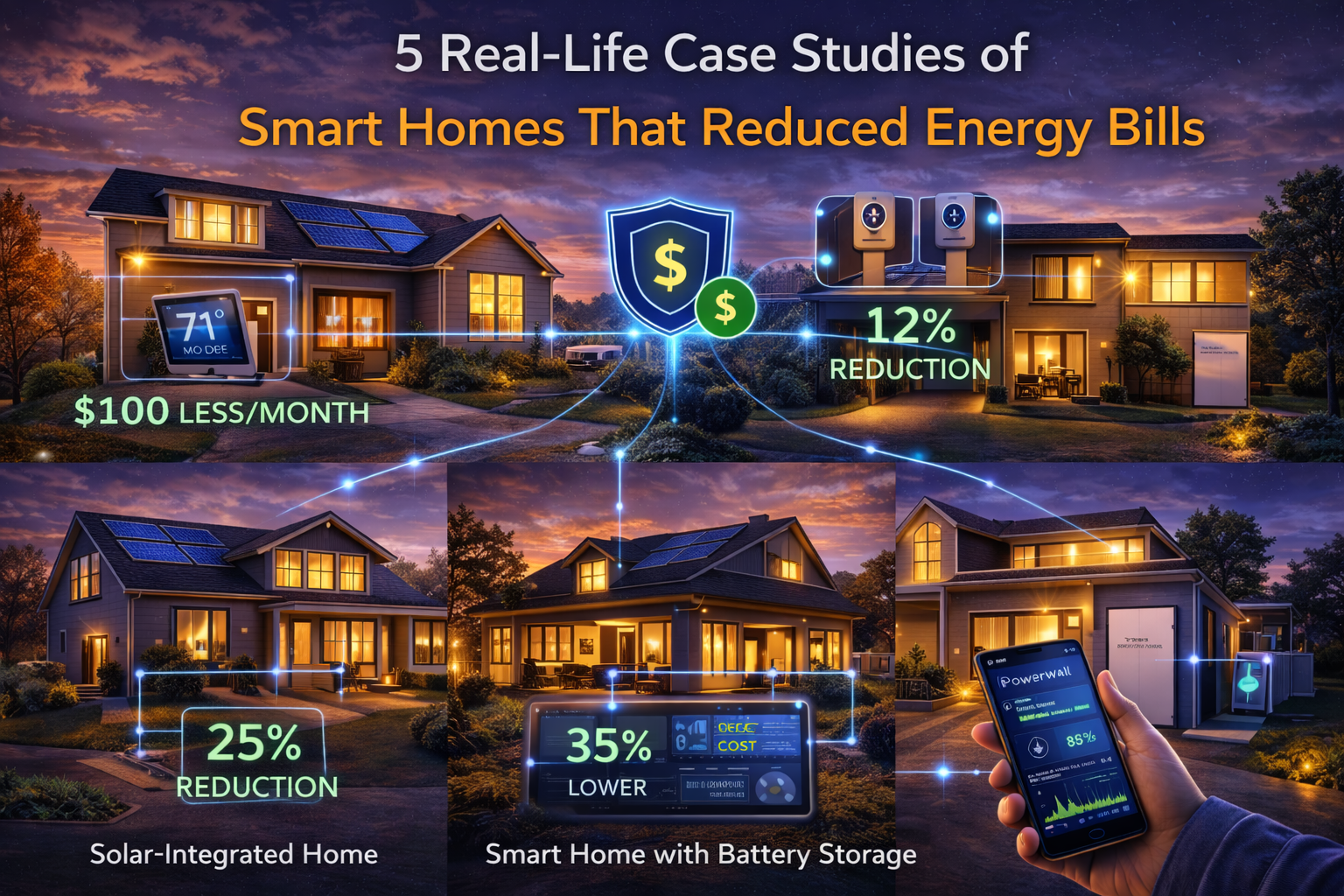
This article presents five realistic case studies of smart homes that reduced energy costs through different approaches. These examples illustrate how building envelope upgrades, automation, solar integration, storage systems, and behavioral optimization combine to create measurable financial impact.
Each case highlights initial conditions, implemented solutions, and outcome analysis to demonstrate what works — and why.
Case Study 1: Suburban Family Home with Smart HVAC Optimization
The first example involves a 2,400-square-foot suburban home located in a warm climate with high summer cooling demand. The household consisted of two adults and two children, with irregular occupancy patterns due to work and school schedules.
Before optimization, the home relied on a traditional programmable thermostat and a single-zone air conditioning system. Annual electricity consumption was significantly influenced by prolonged daytime HVAC runtime during unoccupied hours.
The homeowners installed a smart thermostat ecosystem from Google Nest and integrated motion sensors throughout the home. The system was configured to enter eco-mode automatically when no occupancy was detected and to pre-cool the house before residents returned.
Within the first year, HVAC-related electricity usage declined by approximately 18%. The reduction was achieved without compromising comfort. The key factor was occupancy-based adjustment rather than fixed scheduling.
This case demonstrates that even without solar panels, intelligent climate control produces measurable savings.
Case Study 2: Urban Apartment Reducing Phantom Load
The second example involves a 900-square-foot urban apartment with limited capacity for structural upgrades. The resident worked remotely and had multiple electronics operating daily, including monitors, printers, and entertainment systems.
Energy monitoring revealed a high nighttime base load due to standby consumption. Smart plugs and advanced power strips were installed to eliminate phantom load during sleeping hours.
Automation rules were implemented to cut power to non-essential electronics after midnight and reactivate them in the morning.
Over twelve months, base load consumption dropped by approximately 12%. While the total reduction was smaller than HVAC-focused cases, the investment cost was minimal and ROI was achieved quickly.
This example illustrates that even small dwellings benefit from targeted smart interventions.
Case Study 3: Solar-Integrated Home with Self-Consumption Optimization
The third case involves a 3,000-square-foot home equipped with a rooftop solar system but no initial automation. While solar panels generated significant electricity, a large percentage was exported to the grid at lower compensation rates.
After installing an energy management platform from Enphase Energy, the homeowners began aligning appliance scheduling with peak solar production.
Laundry cycles, dishwasher runs, and electric vehicle charging were shifted to midday production windows. Additionally, minor HVAC pre-cooling reduced evening grid dependence.
Self-consumption increased from 48% to 72%, resulting in a noticeable reduction in grid imports. The total electricity bill decreased by approximately 25% compared to the previous year.
This case highlights the importance of synchronization between generation and consumption.
Case Study 4: Smart Home with Battery Storage and Peak Shaving
The fourth example involves a home located in a region with aggressive time-of-use pricing. Peak electricity rates were significantly higher during evening hours.
The homeowners installed battery storage, including a Tesla Powerwall, integrated with a solar array and automated energy management.
The battery charged during peak solar production and discharged during high-cost evening windows. HVAC usage was slightly pre-shifted before peak rate periods.
The result was a 35% reduction in peak-hour grid purchases. Although total kWh consumption did not decline dramatically, cost savings were substantial due to tariff optimization.
This case demonstrates that intelligent load shifting can be as impactful as reducing overall consumption.
Case Study 5: New Construction with Integrated Systems Approach
The final example involves a newly built 2,800-square-foot smart energy-efficient home designed from the ground up.
The project incorporated:
- High-performance insulation
- Zoned inverter heat pump
- Solar array
- Battery storage
- Full Energy Management System integration
- Occupancy-based automation
Because efficiency was embedded during construction, system sizing was optimized and HVAC load requirements were reduced from the outset.
Compared to similarly sized conventional homes in the same region, annual electricity costs were approximately 60% lower.
This case underscores the advantage of systems-level design. When efficiency, automation, generation, and storage are planned together, compounding benefits occur.
Common Themes Across All Case Studies
Despite differences in home size, budget, and location, several patterns emerged consistently.
First, occupancy awareness significantly reduces unnecessary runtime. Whether through smart thermostats or security integration, detecting presence is central to optimization.
Second, load shifting produces meaningful cost savings in time-of-use markets.
Third, solar without automation underperforms compared to integrated systems.
Fourth, structural efficiency improvements amplify the impact of technological upgrades.
Most importantly, no single device produced dramatic change independently. Savings resulted from coordinated implementation.
Authority Insight: Real Savings Require Systems Thinking
These case studies reinforce a critical principle: energy efficiency is cumulative and systemic.
Homeowners often search for a single device that reduces bills dramatically. In practice, savings emerge from layered improvements — climate optimization, behavioral adjustments, load shifting, renewable integration, and intelligent coordination.
From an engineering perspective, the most successful homes treat energy as an ecosystem rather than isolated components.
Technology alone does not create savings. Strategic integration does.
Frequently Asked Questions
Are these savings typical for most homes?
Results vary by climate, tariff structure, and system integration. However, measurable reductions are achievable in most environments.
Is solar necessary for significant savings?
No. HVAC optimization and phantom load reduction alone can produce noticeable improvements.
Do batteries always improve ROI?
Not universally. Battery value depends heavily on time-of-use pricing and grid reliability.
How long does it take to see savings?
Many homeowners observe reduced bills within the first billing cycle after proper automation configuration.
Is professional installation required?
Complex integrations benefit from professional setup, but many smart devices are user-configurable.
Final Considerations
Real-world examples demonstrate that smart homes can reduce electricity bills when efficiency strategies are implemented thoughtfully.
The most important lesson is not that technology alone produces savings, but that coordination between systems amplifies impact.
Whether starting with smart thermostats, load scheduling, solar integration, or full-scale new construction, the pathway to lower energy costs lies in structured planning.
Energy optimization is not theoretical. It is measurable, repeatable, and scalable when approached strategically.

Daniel Harper is a graduate engineer with a postgraduate specialization in Intelligent Solutions and Industry 4.0 technologies. He leads the Mogarzi Team, focusing on smart home automation, residential energy efficiency, and intelligent energy management systems. His work combines engineering principles with practical home optimization strategies, translating complex technical concepts into actionable insights for homeowners seeking smarter and more efficient living environments.